Hasami
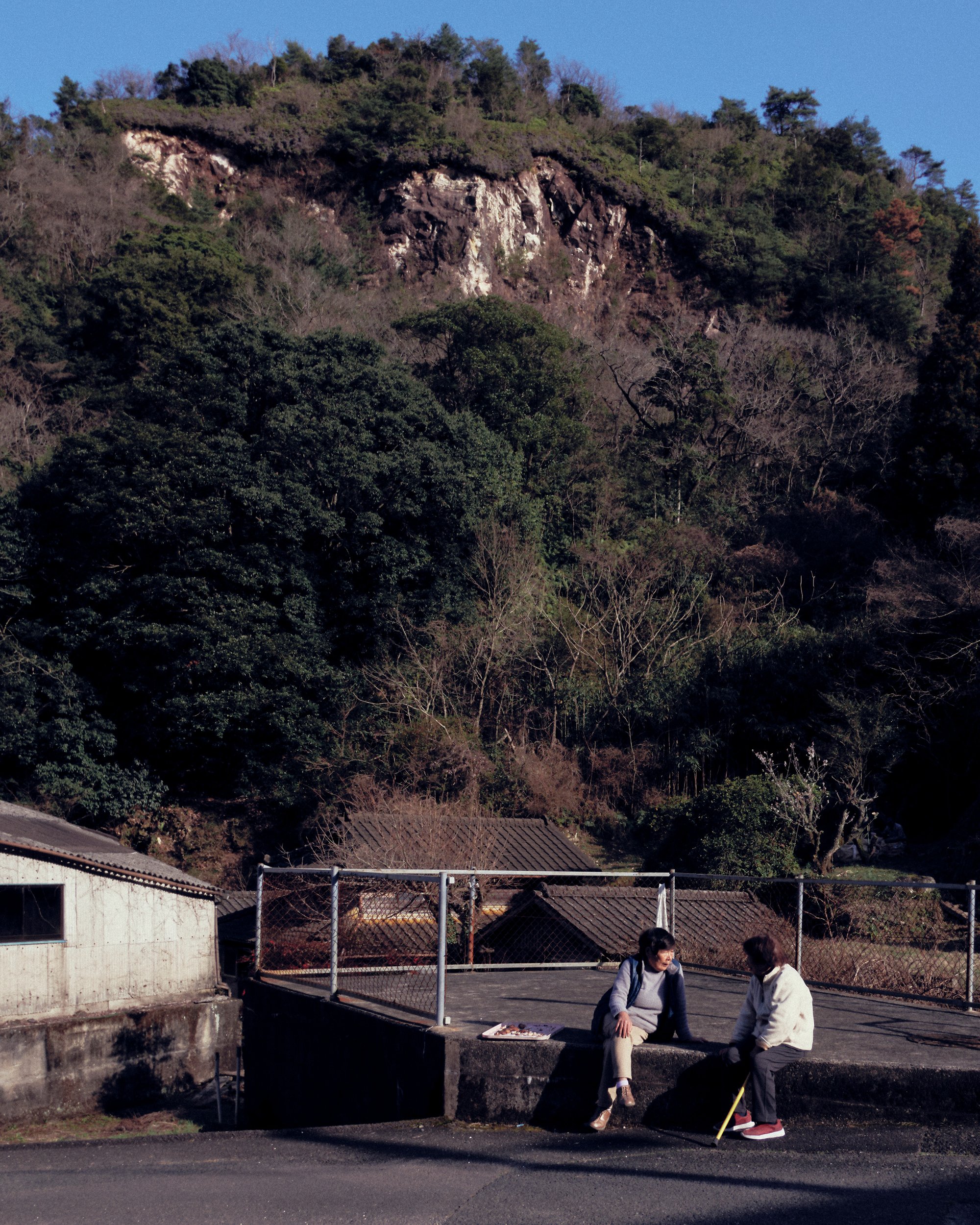

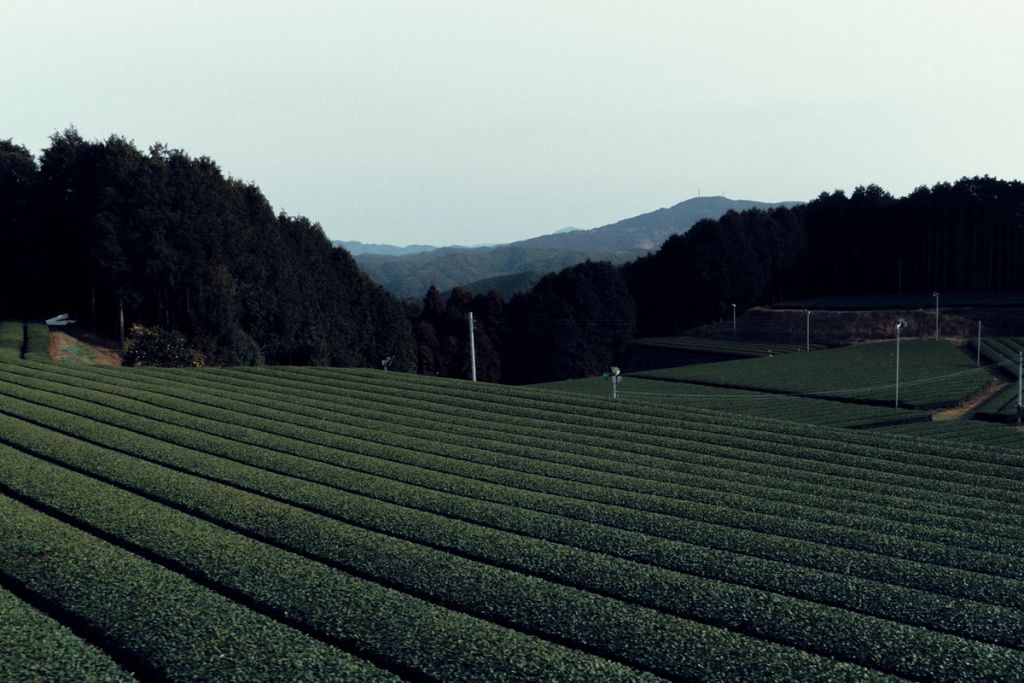
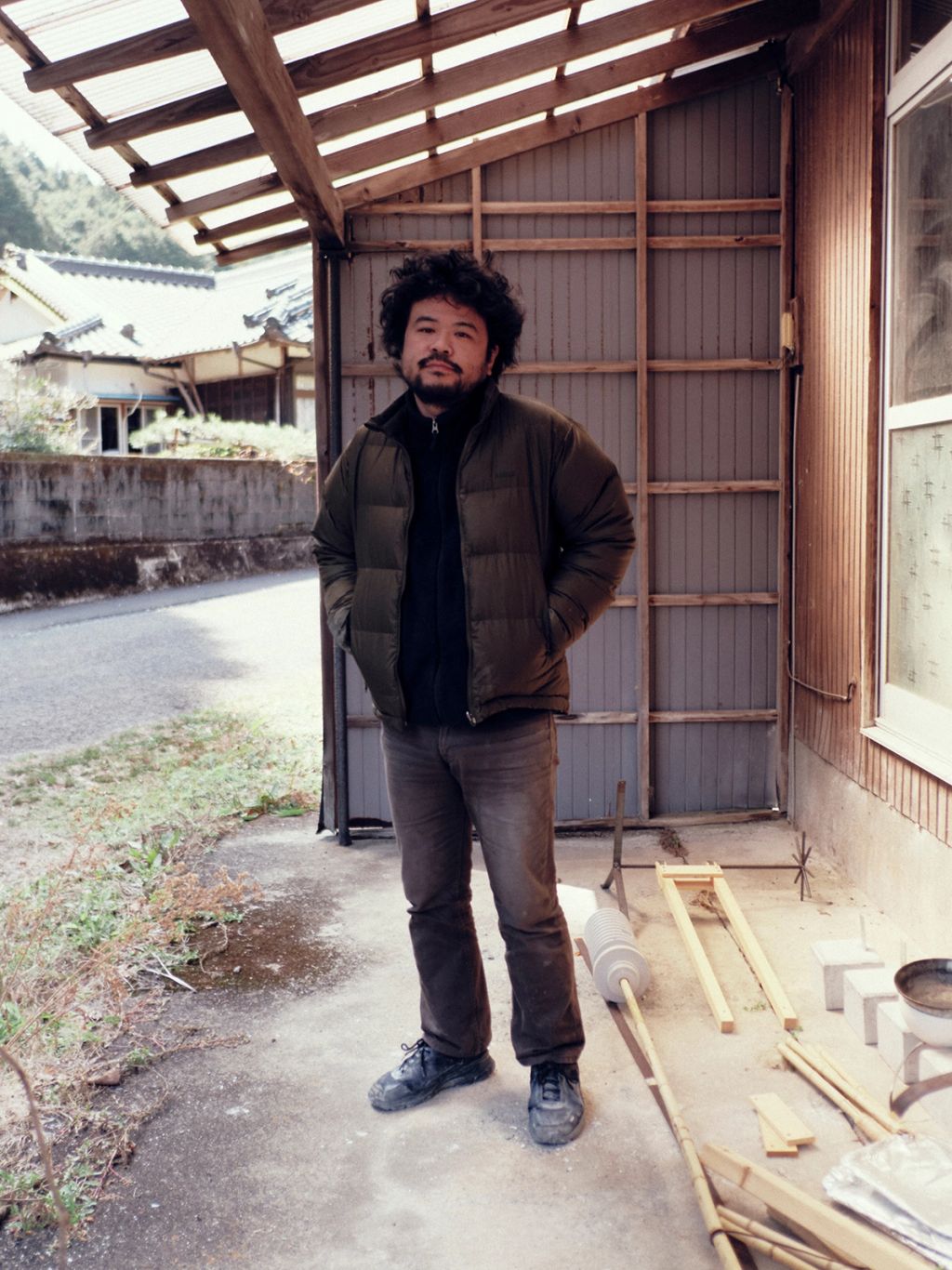
We arrived in Hasami, a small town north of Nagasaki Prefecture, on a warm early spring day. With a population of about 14,000, locals say the town resembles the shape of a cat’s face. Surrounded by mountains, it is the only town in the prefecture that does not face the sea. For us Tokyoites, it felt incredibly spacious and instantly nostalgic; passersby greeting one another is a kind of friendliness missed in the city.
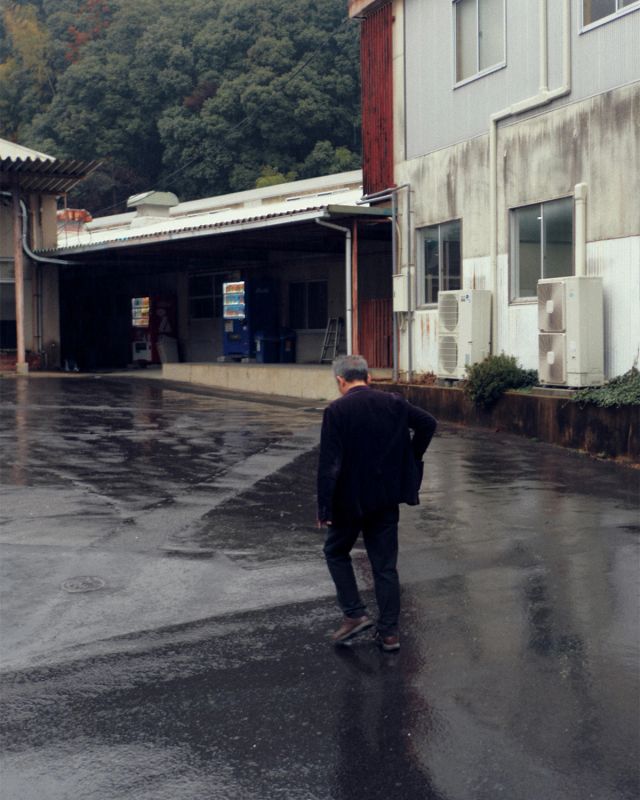
As we drove past stretches of lush green wheat fields, we saw traces of a 400-year-old ceramic industry everywhere: century-old houses, brick chimneys, and the faded signage of former pottery studios. Hasami has no major tourist attractions, and few people come without a specific reason—but it offers many reasons to stay. There’s nothing flashy about it, and it doesn’t try to be. Instead, there’s a rare, quiet abundance in the people, the work, and the surrounding nature.
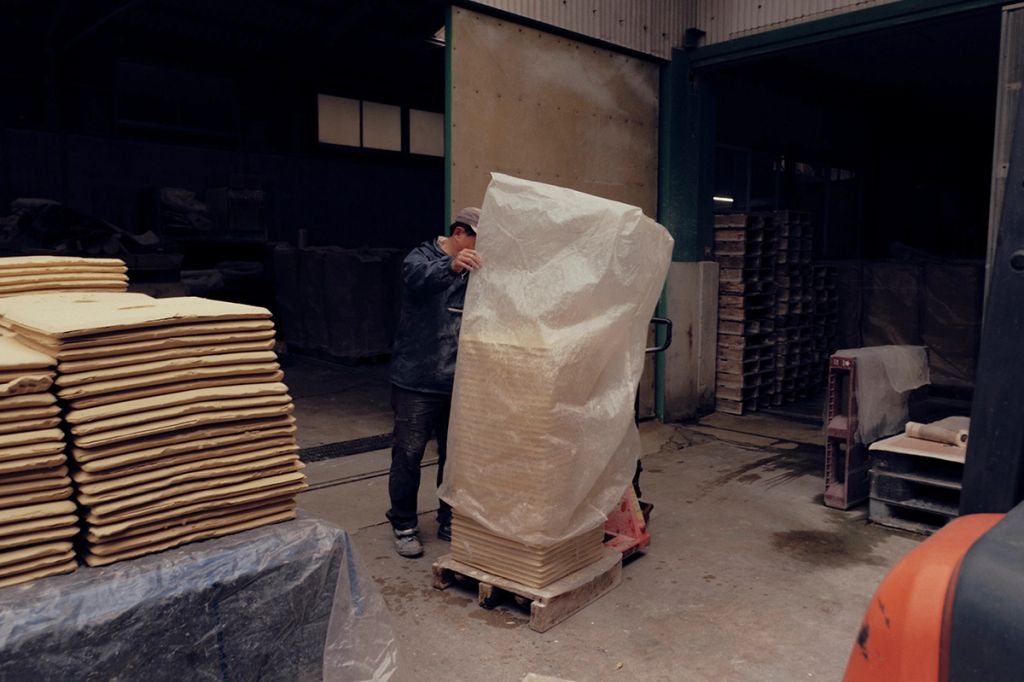
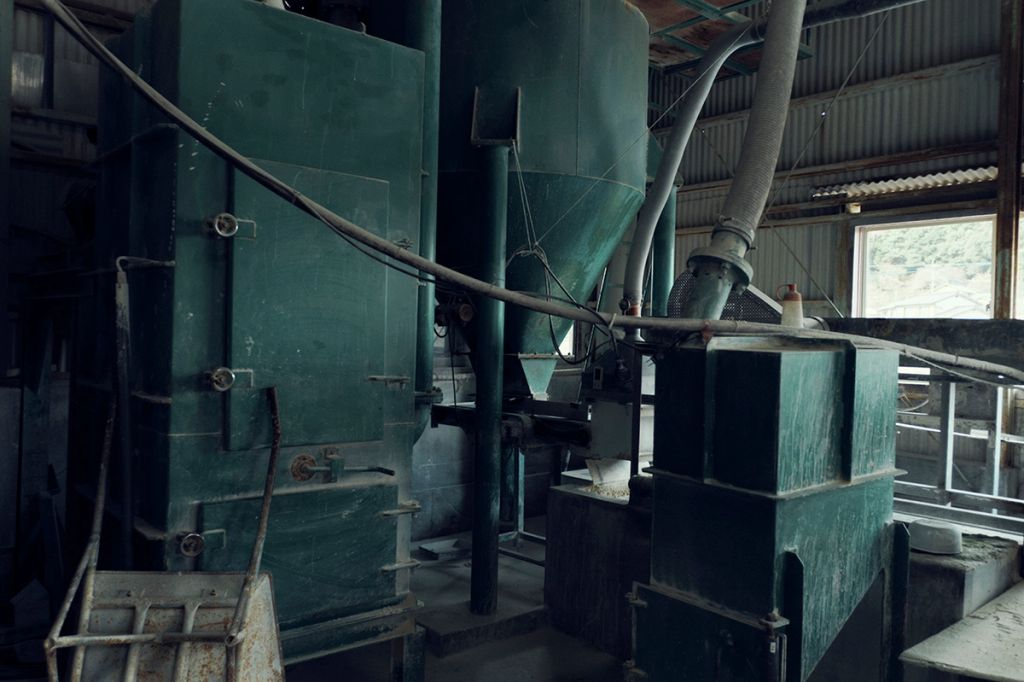
When I was asked to write about this town—known for producing about 17 percent of Japan’s daily-use ceramics—I thought I knew what to expect. But Hasami seems to exist beyond the average person’s understanding. For centuries, its wares were produced and sold under the name Arita-yaki (有田焼); only in the 2000s did Hasami-yaki (波佐見焼) begin to receive recognition in its own right.
Arguably, Hasami is more than just a ceramic town. Somewhat removed from everything else, it has built its reputation on a highly specialized division of labor known as bungyōsei (分業制), with techniques passed down through generations. Its success depends on more than craftsmanship—it is an industry shaped by community, resilience, and a willingness to welcome new people and ideas.
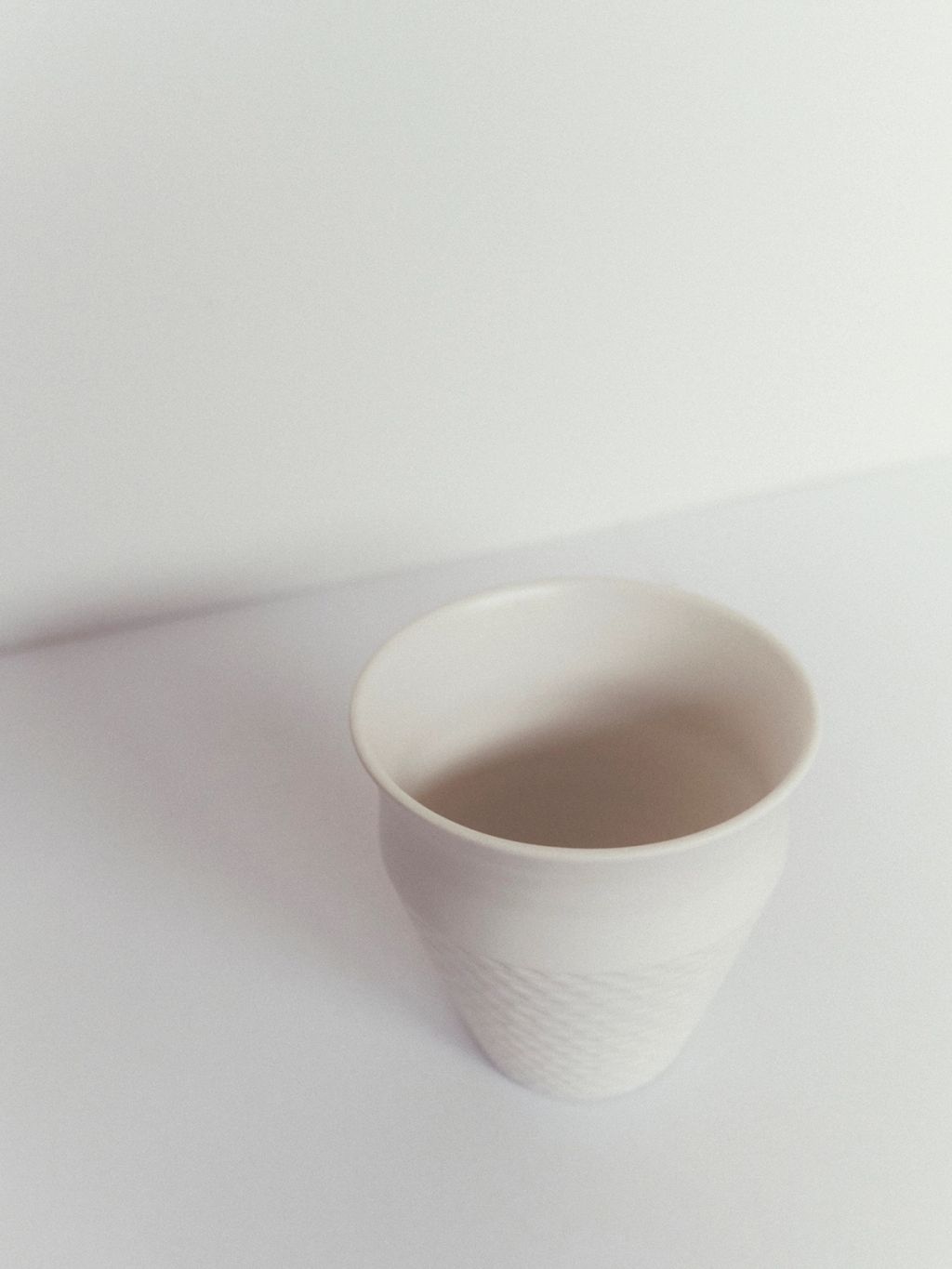
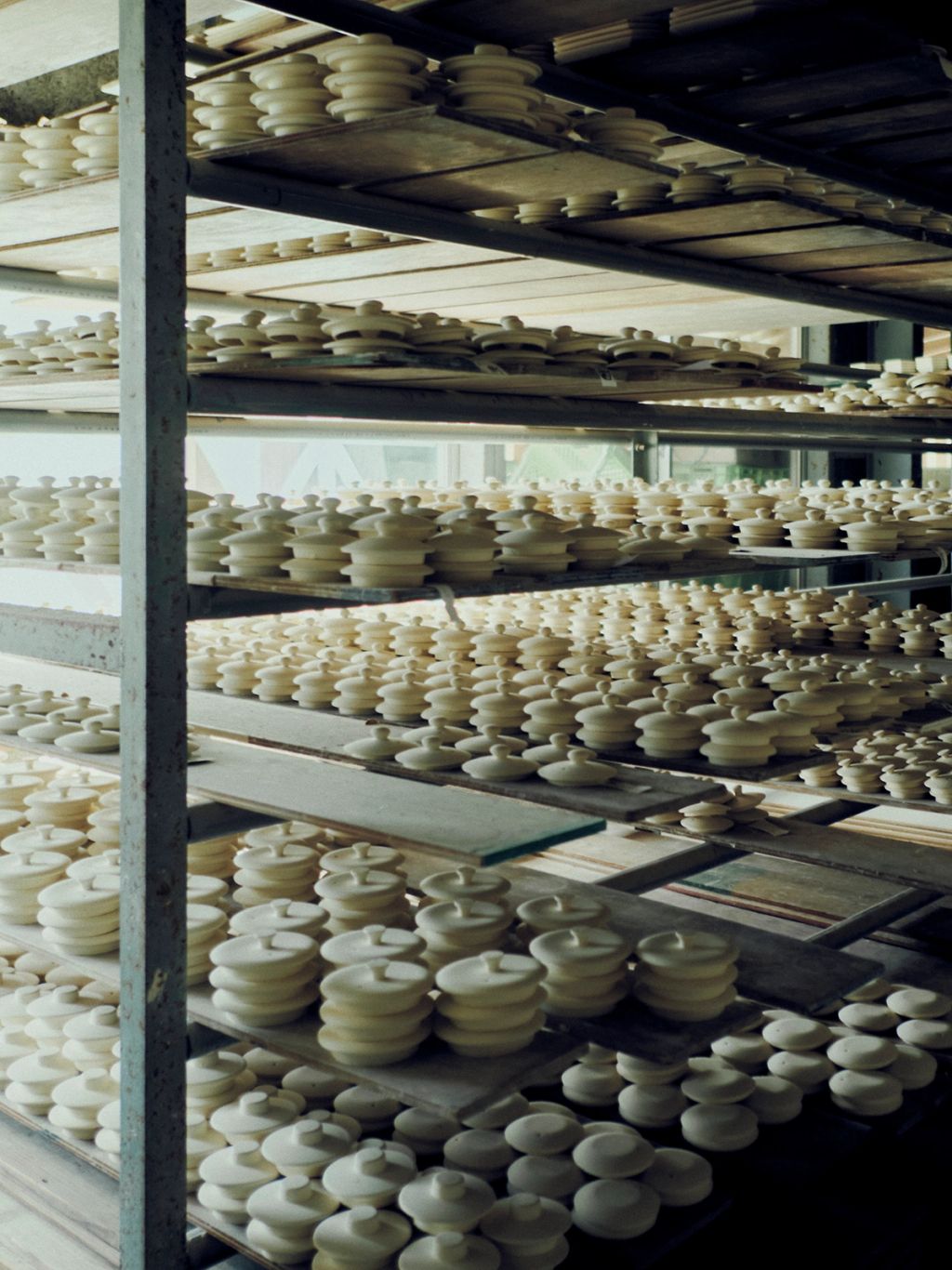
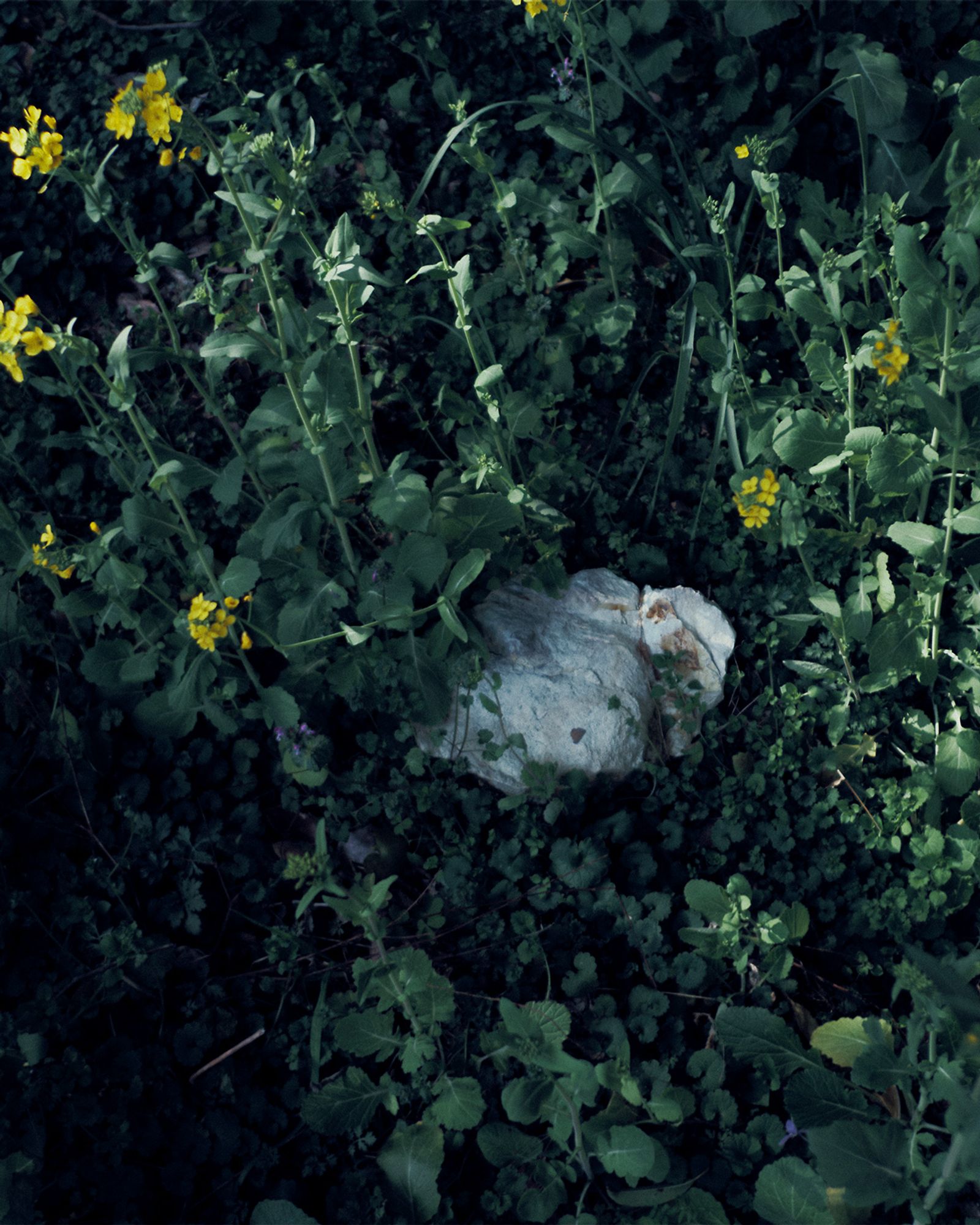
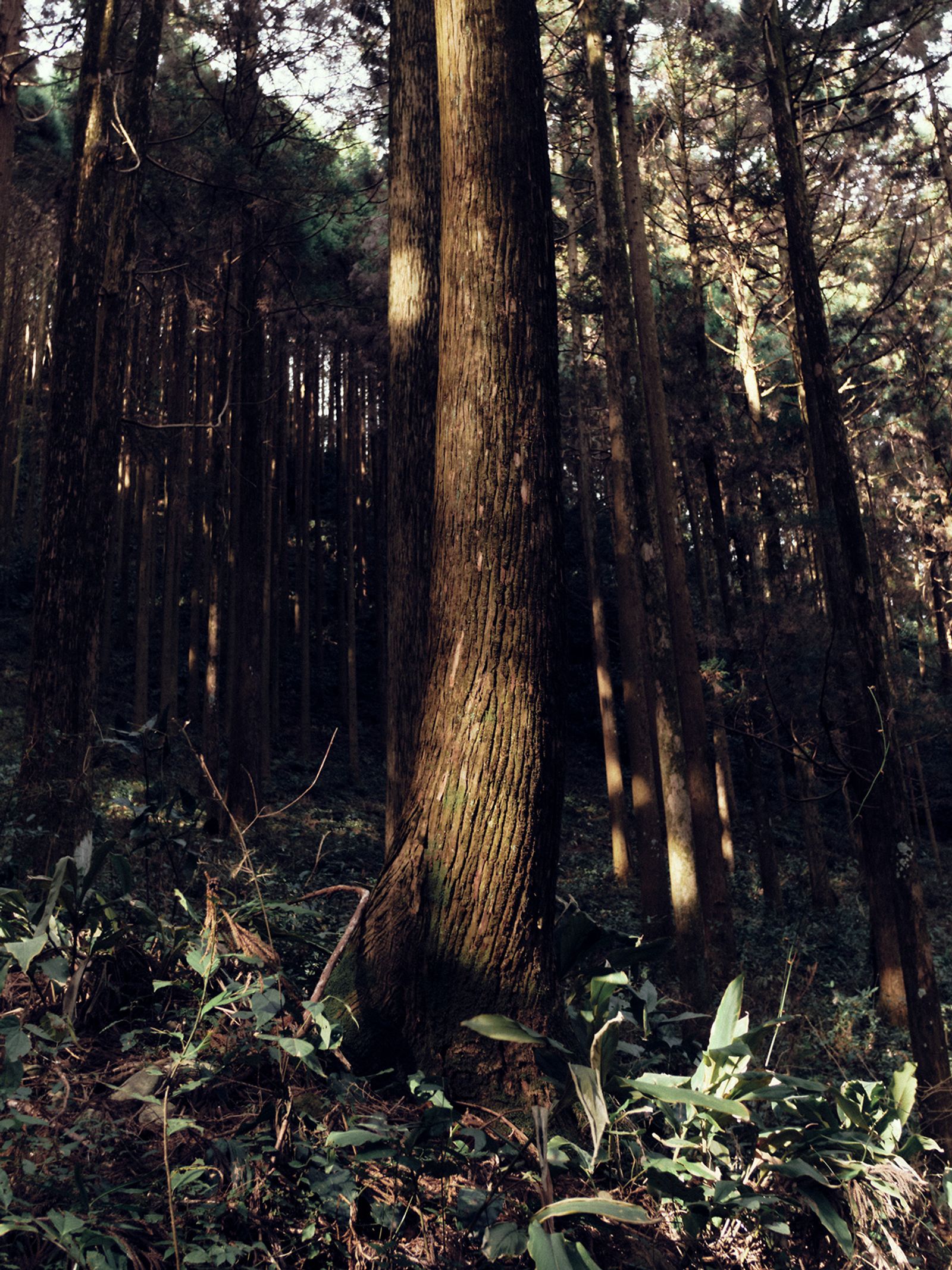
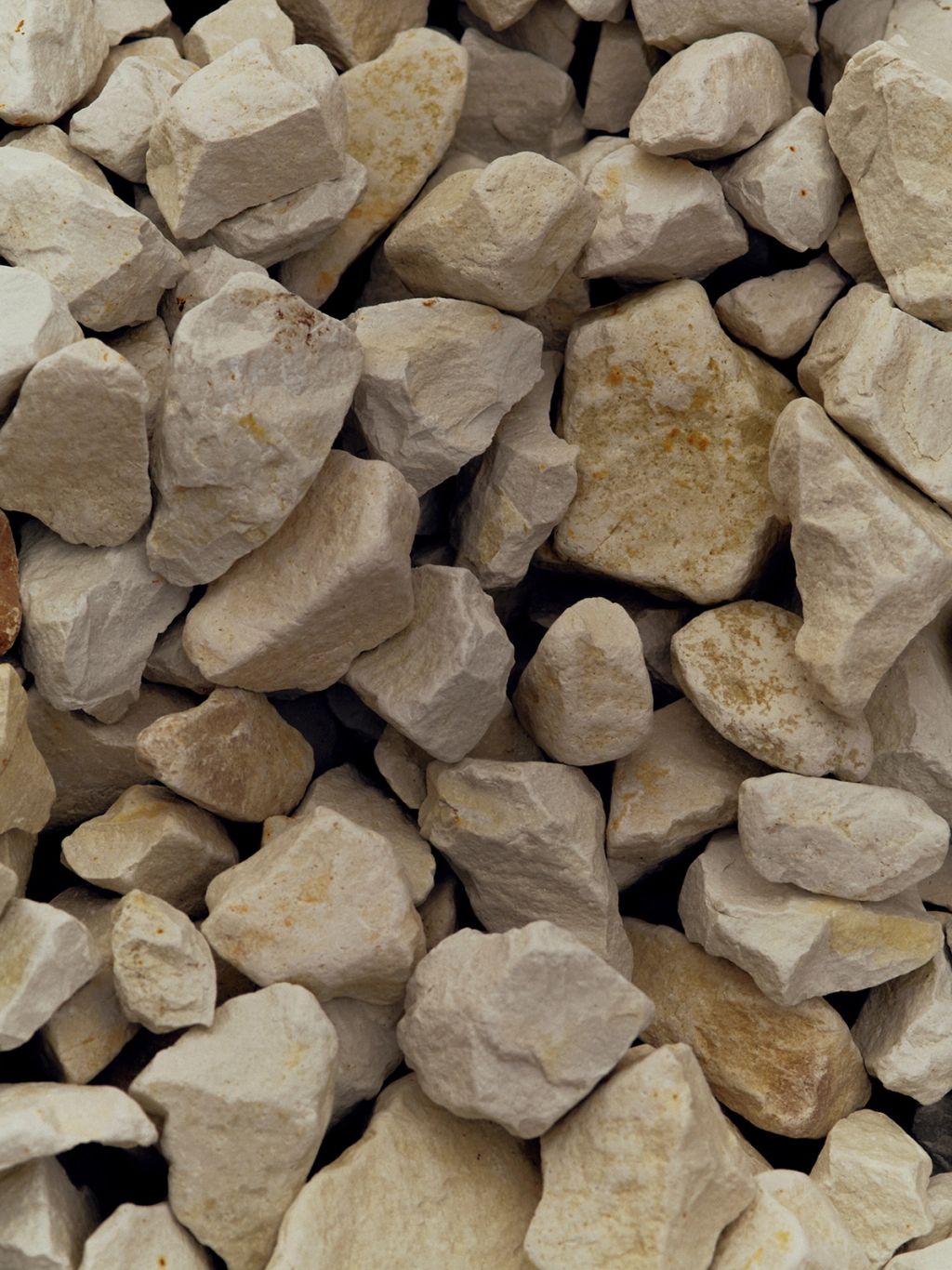
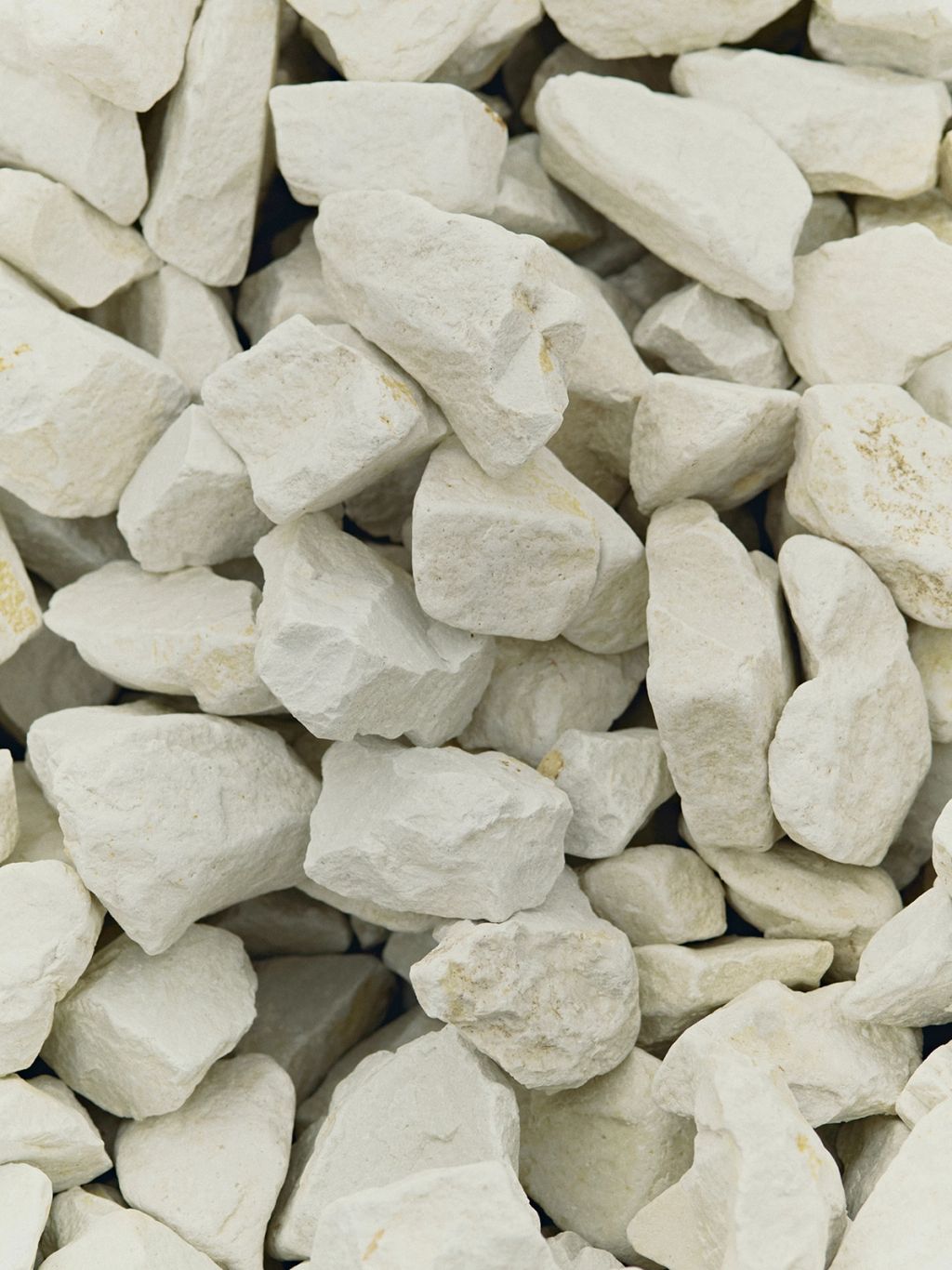
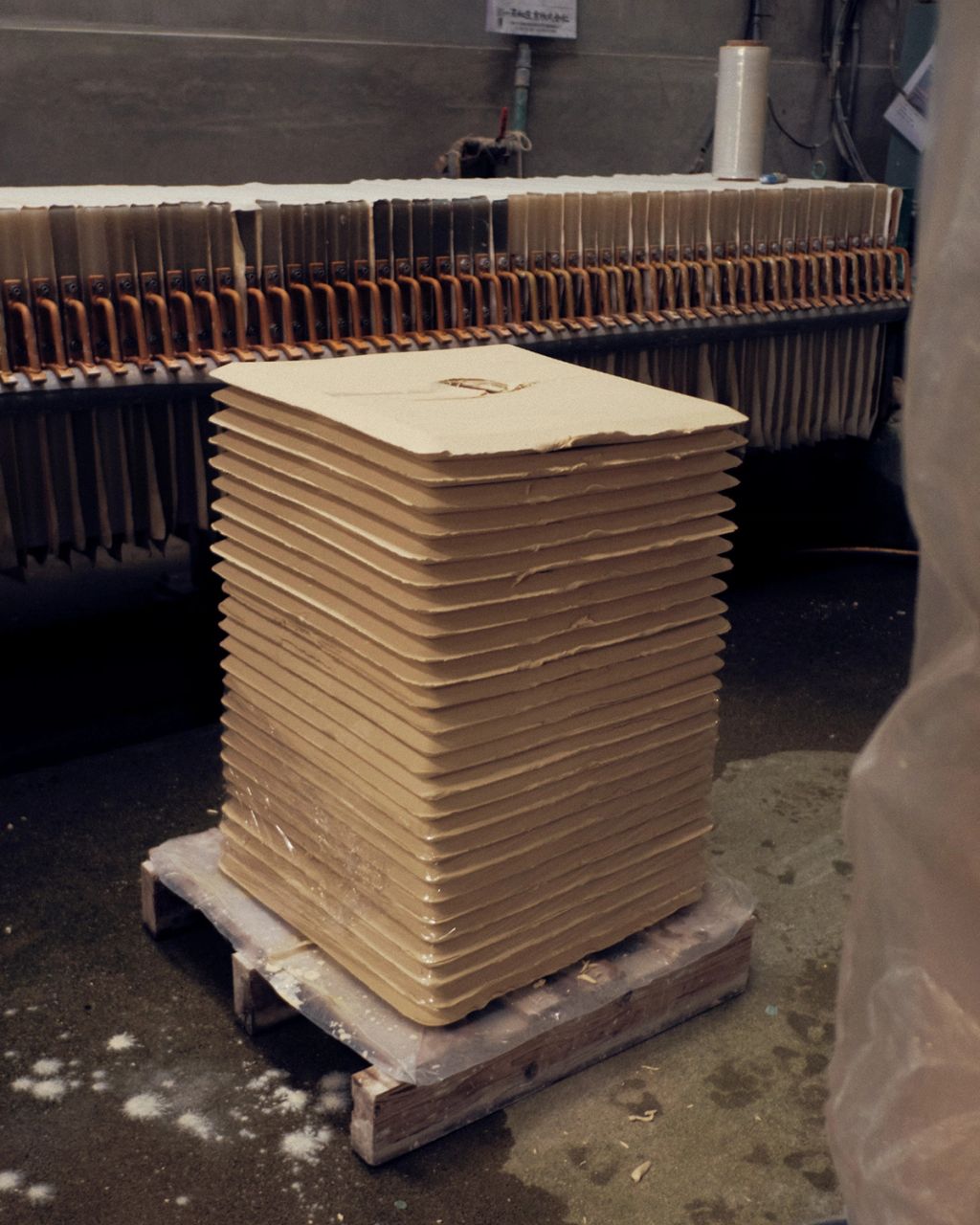
Hasami, as it turns out, is a trifecta for ceramic production: surrounding mountains that yield pottery stone—the raw material processed into clay—rivers that provide water, and akamatsu pine from the forests used as firewood. It felt as though the town’s life work — unknowingly, of course — had always been to produce ceramics on this very land. I was shocked, almost skeptical, that everything that was needed for ceramic production existed so readily without people deliberately manufacturing the environment for profit.
I have never seen pottery stones in the wild, and I would assume most of us haven’t. Beneath us in the river lay a moss-covered, rugged white rock, flecked with grey, large enough to feel like its own landscape. It looked exactly like what you see when you look down from an airplane—a patchwork of fields. It was a pottery stone—one of many lying quietly around the area. The river was so clear we could almost see the bottom of the stone, where it rooted itself beneath the water. There was something almost omniscient about it: a stone shaped over centuries by the force of the river, rain, and wind.
It felt kismet and it only made sense that over centuries, the people of Hasami adapted their wellbeing and livelihoods with nature —not against it.

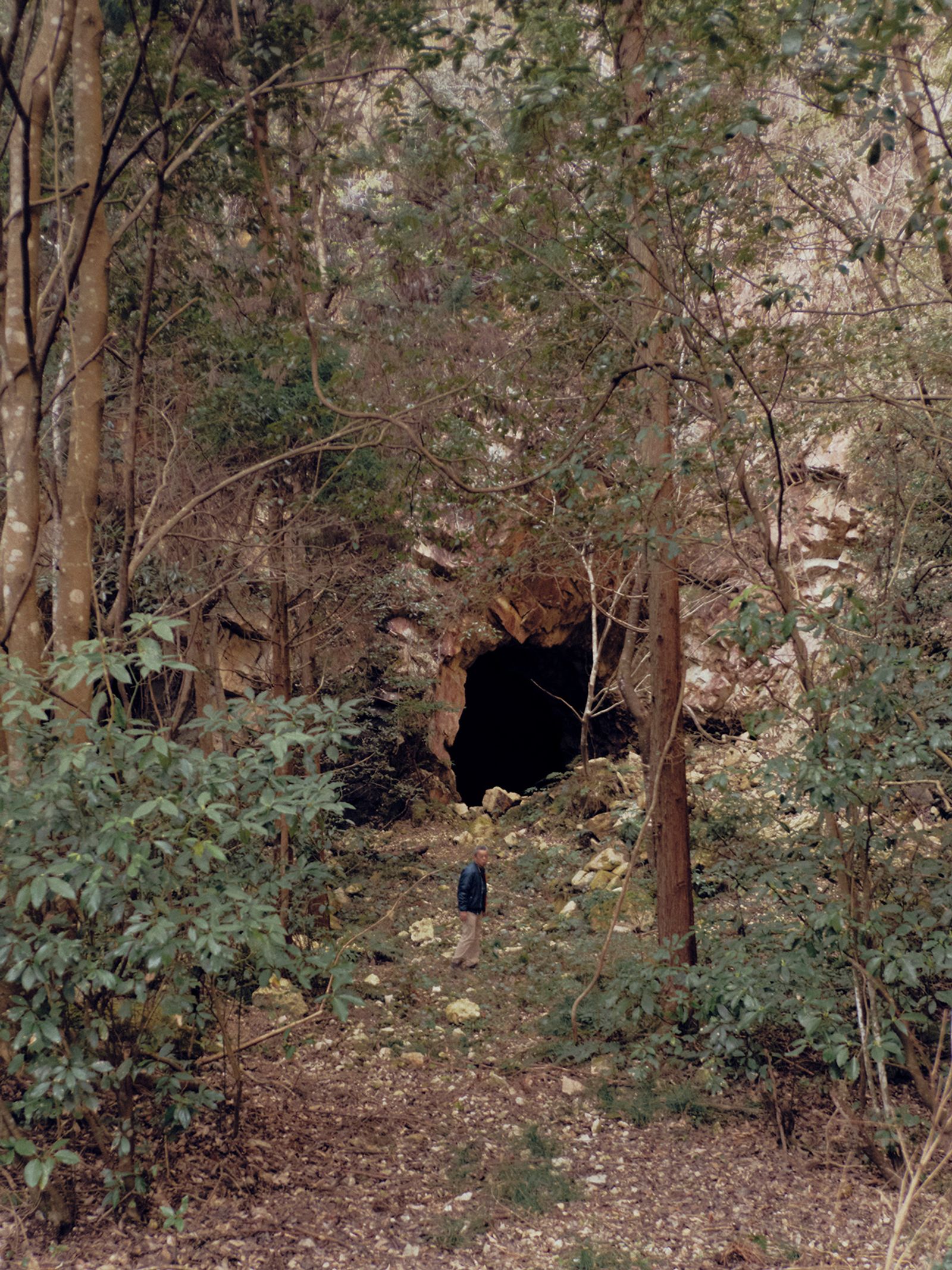

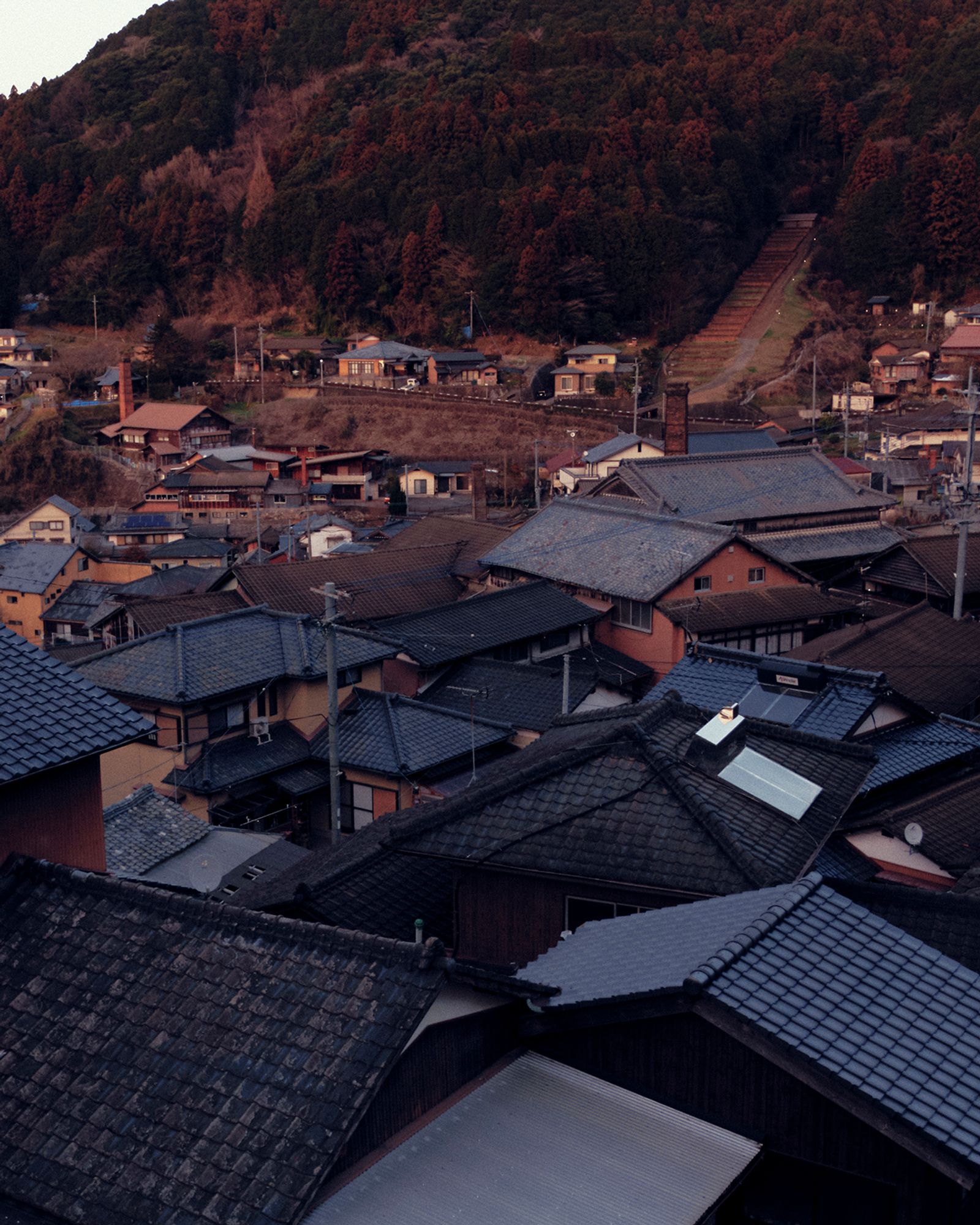
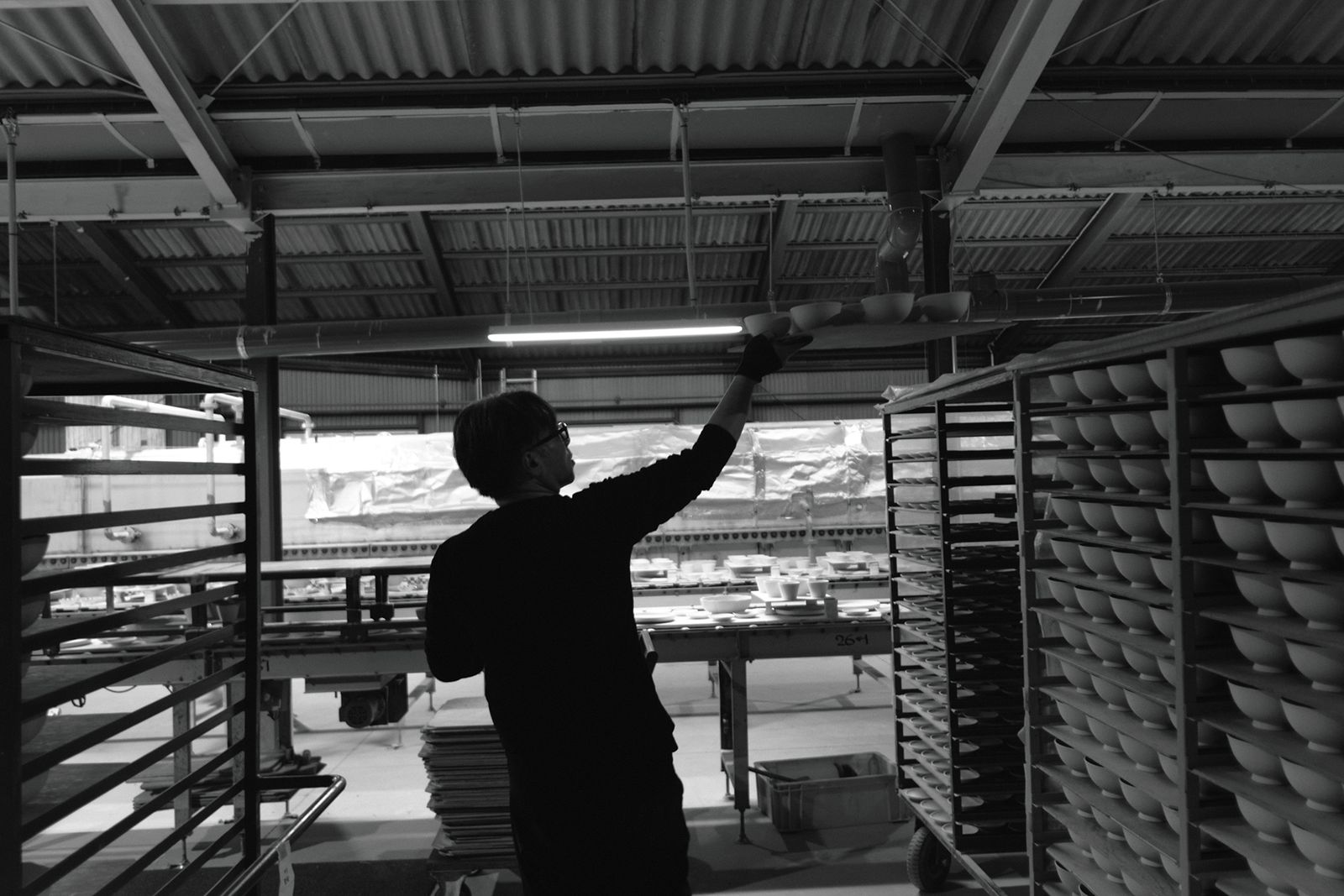
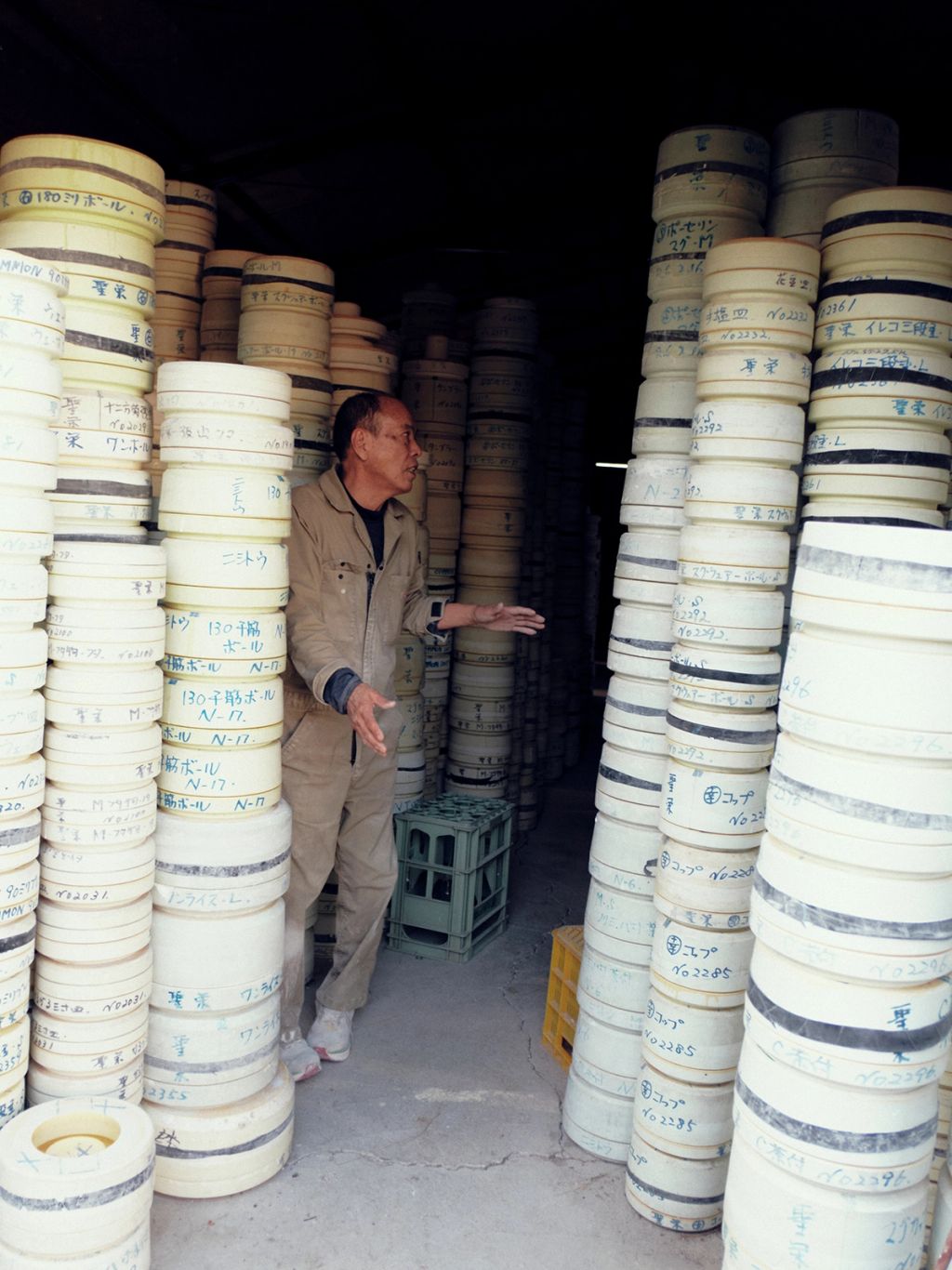
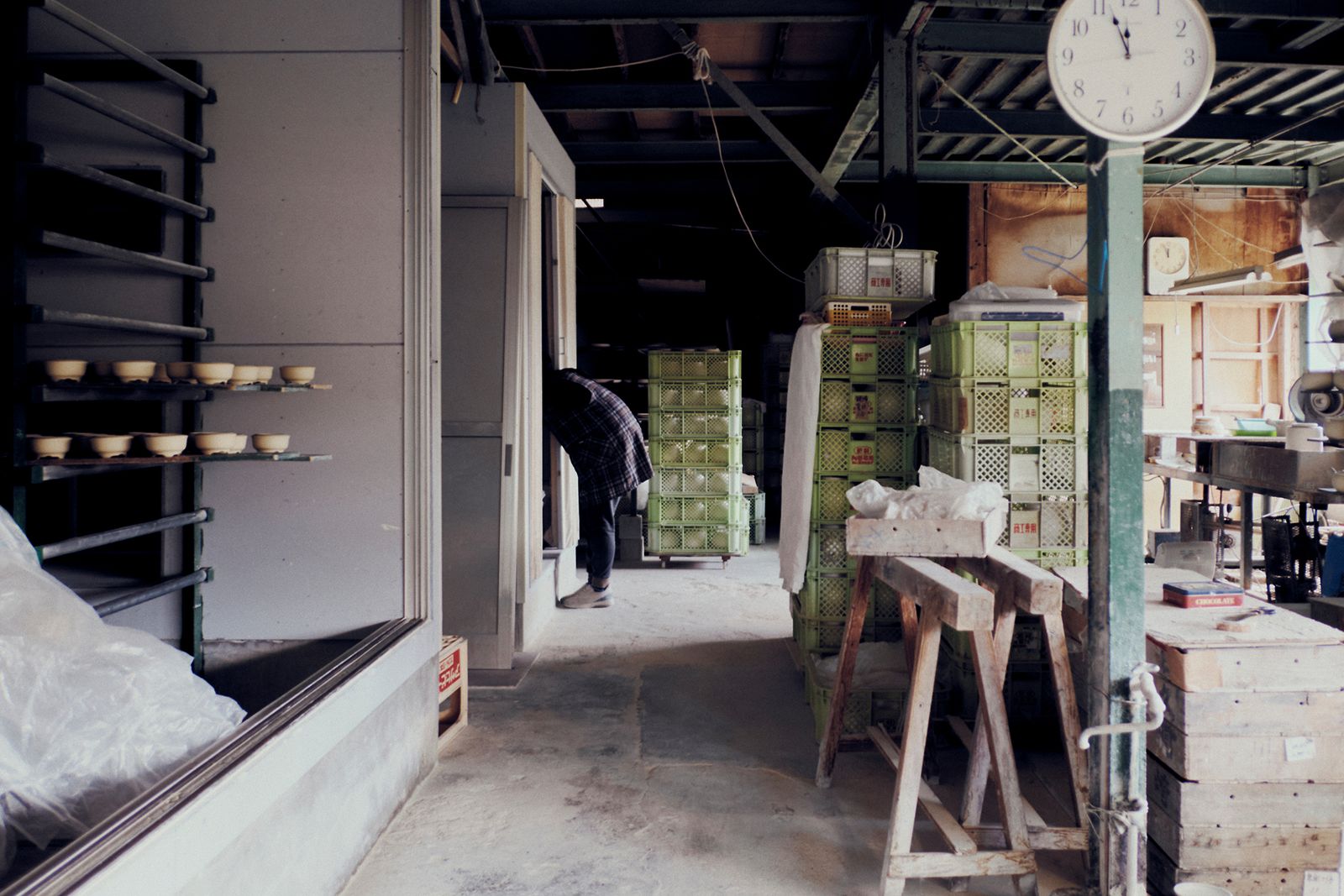
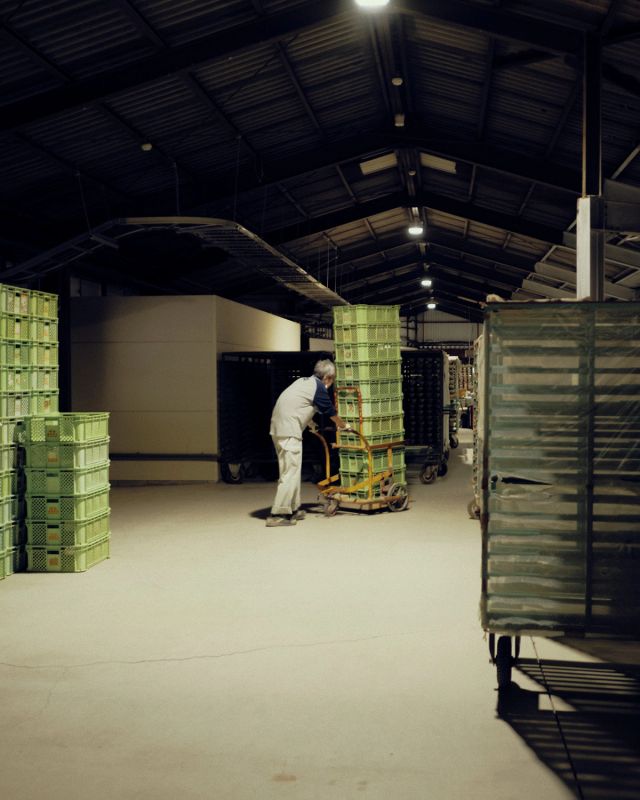
Nakaoyama —located just a few minutes from central Hasami— is known as one of the areas that supported the mass production of Hasami ware from as far back as the Edo period. Now most of the houses are empty, but I could picture the pottery town that once thrived here: worn green crates once used to ship ceramics, plaster molds left behind, and fragments of broken plates scattered along the paths. Now, there are roughly only 100 people left in Nakaoyama, but it was once a town bursting with people working in the industry altogether. The houses were built tightly next to each other, almost without space between them. It made it easier to carry clay, molds, and finished ceramics on long wooden planks, squeezing through the narrow paths to deliver pieces from one workshop to another.
At a viewpoint in Nakaoyama, we could see one of the world’s largest climbing kilns in the distance. This kiln embodies a shared, communal spirit as everyone in Nakaoyama once used the same kiln to fire their ceramics. The Nakaoue climbing kiln site stretches nearly 160 meters and once contained 33 firing chambers. Climbing kiln, also known as noborigama (登り窯) is exactly how it sounds like; it’s a series of stepping kiln chambers along the hillside of the mountains. This ensures the heat to travel efficiently from the lower chambers upward, making it easier to maintain an even temperature throughout the entire kiln. It was also the perfect invention during the mass production period to fire as many ceramics at once.
The structure of the climbing kilns harnessed the landscape that already existed in Hasami working with nature’s resources. The results of the ceramics created in climbing kilns were magic — the final results in color and the finish are up entirely by nature’s work.
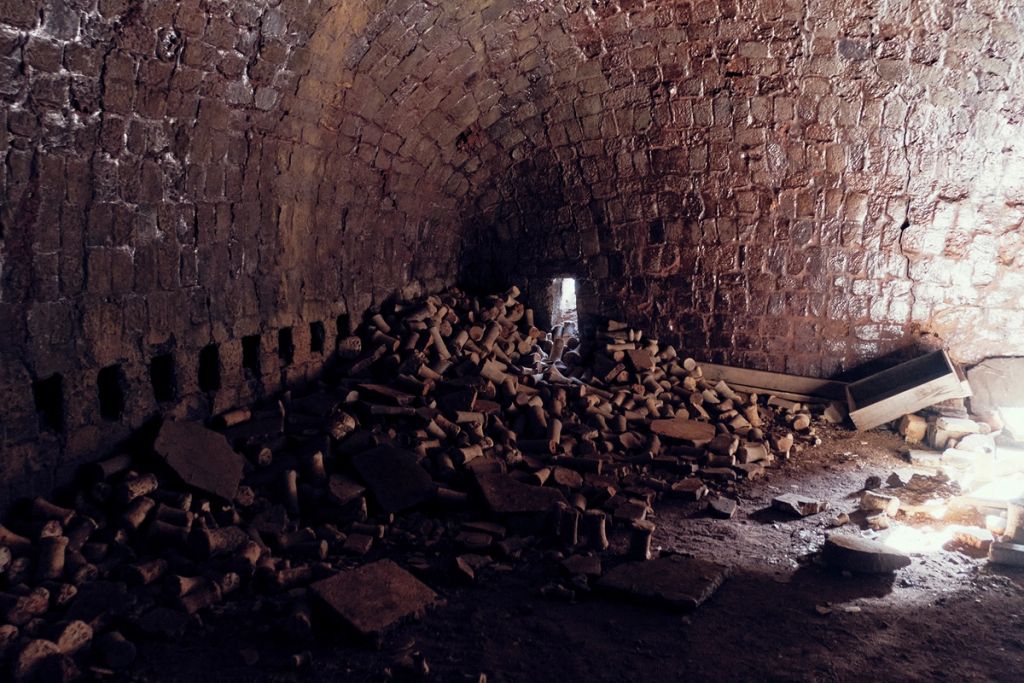
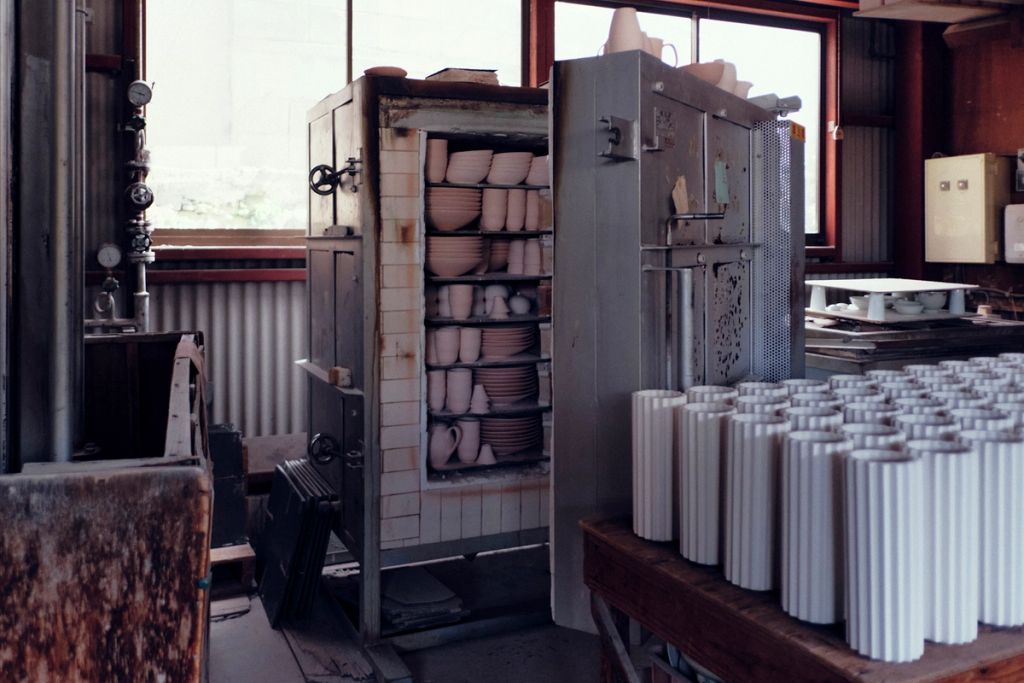
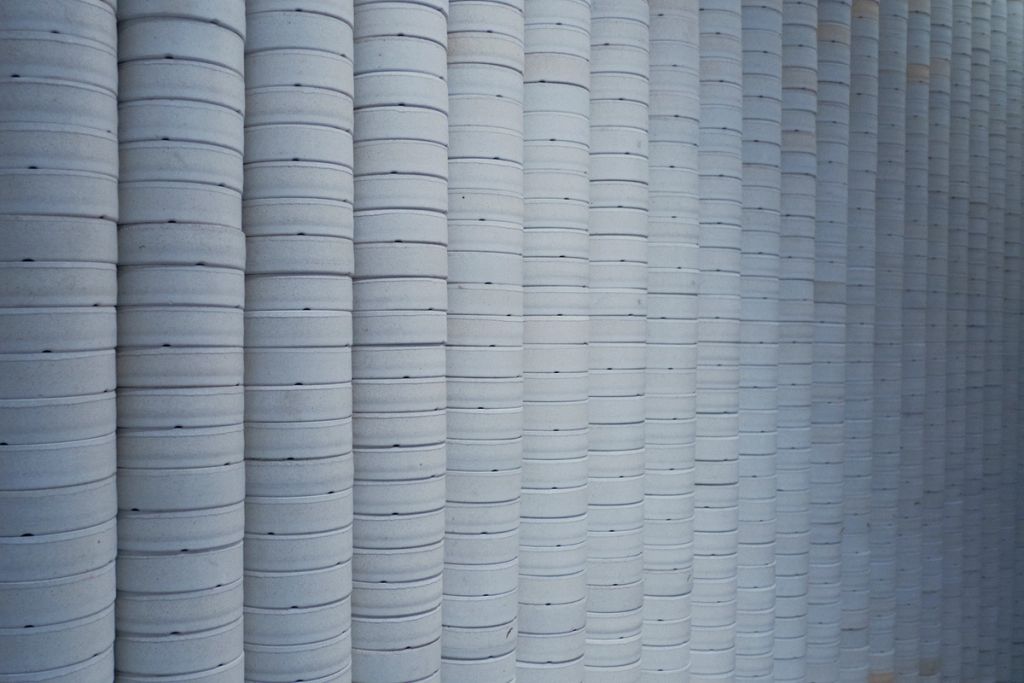
As you learn about climbing kilns and how it was made, it sounds extremely laborious — and it was. The kiln was made by hand using red bricks, workers carrying it up to the hillside of the mountains. Our confidant and trusted local guide, Kobayashi-san told us that no one alive today can replicate its construction anymore.
In Japan, this kind of practice in labor and effort is known as tema (手間). It’s loosely translated as the time and effort put in by one’s hands. At a glance, we can hardly pin down the intricacies, the labor, and the time that is put into our everyday rice bowls. However, after visiting Hasami, recognizing the efforts put into a single ceramic piece becomes palpable. I once read something from a Dassai (獺祭) sake maker when learning about the essential aspect of craft in Japan: there is no true understanding of a craft unless people recognize the effort —the tema—behind it all. Without tema, there is no product, a value that is often dismissed in the West as inefficient or a waste of time.
According to the official Nagasaki Prefecture website, Hasami has a total working population of about 8,400 people, many of whom are involved in the ceramic industry. We saw how everyone in Hasami has an essential role in every process.
As we witnessed, nature, of course, plays a mammoth role in ceramic making, but I have never seen anything quite like the way Hasami functions almost as one big family: somebody is someone’s parent, grandparent, cousin, nephew, or friend. The industry is built on shared practice, shared spaces, and shared beliefs passed down through centuries among families and neighbors. No one is out of sync—just like cogs in a well-oiled machine.
At times during our trip, we questioned whether any part of the craft or process could be replaced by machines. It’s not a radical line of questioning, as the town is also facing population decline and aging, just like many other rural cities in Japan.
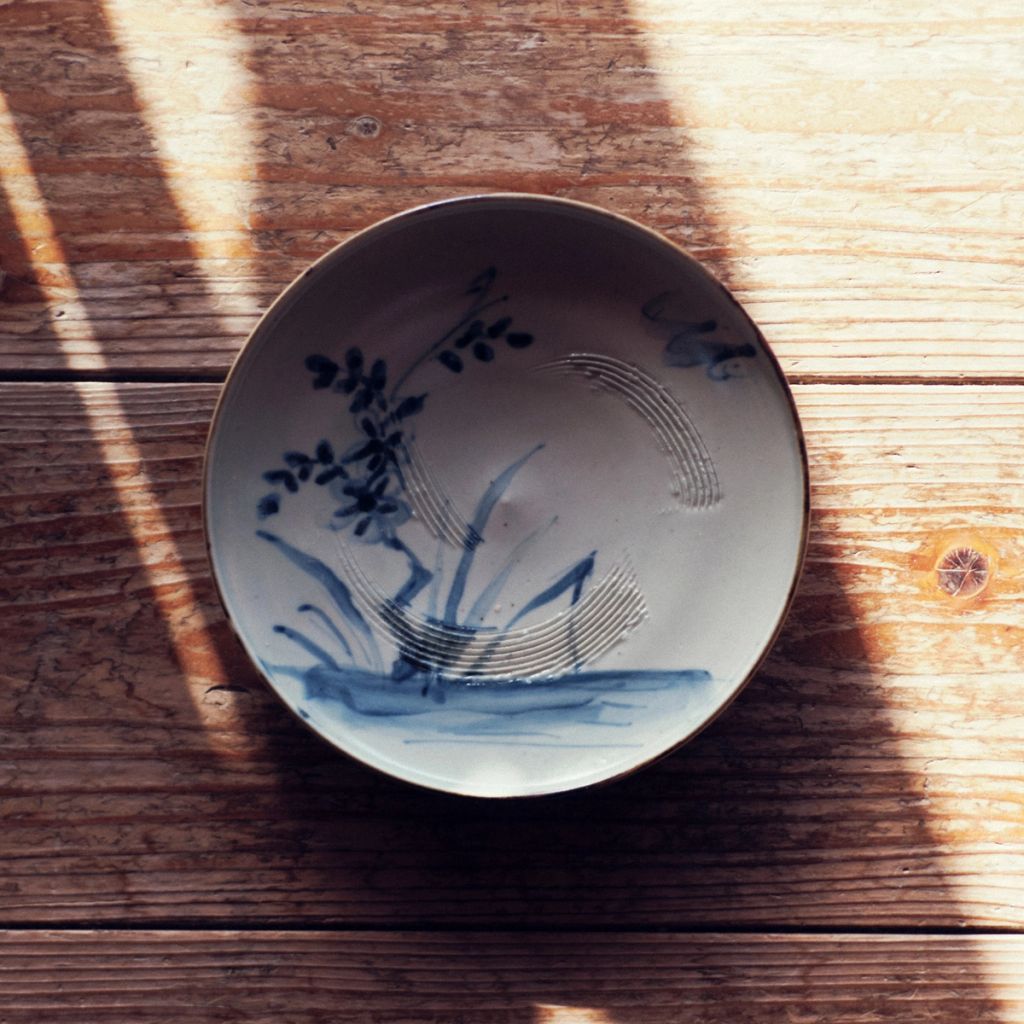
When cropping out a single brushstroke on a rice bowl design, it might not look like much at a glance, but the truth is, without that single brushstroke—a line or the stem of a flower—there would never be a complete product.
Img. 01
Img. 02
Img. 03
Img. 04
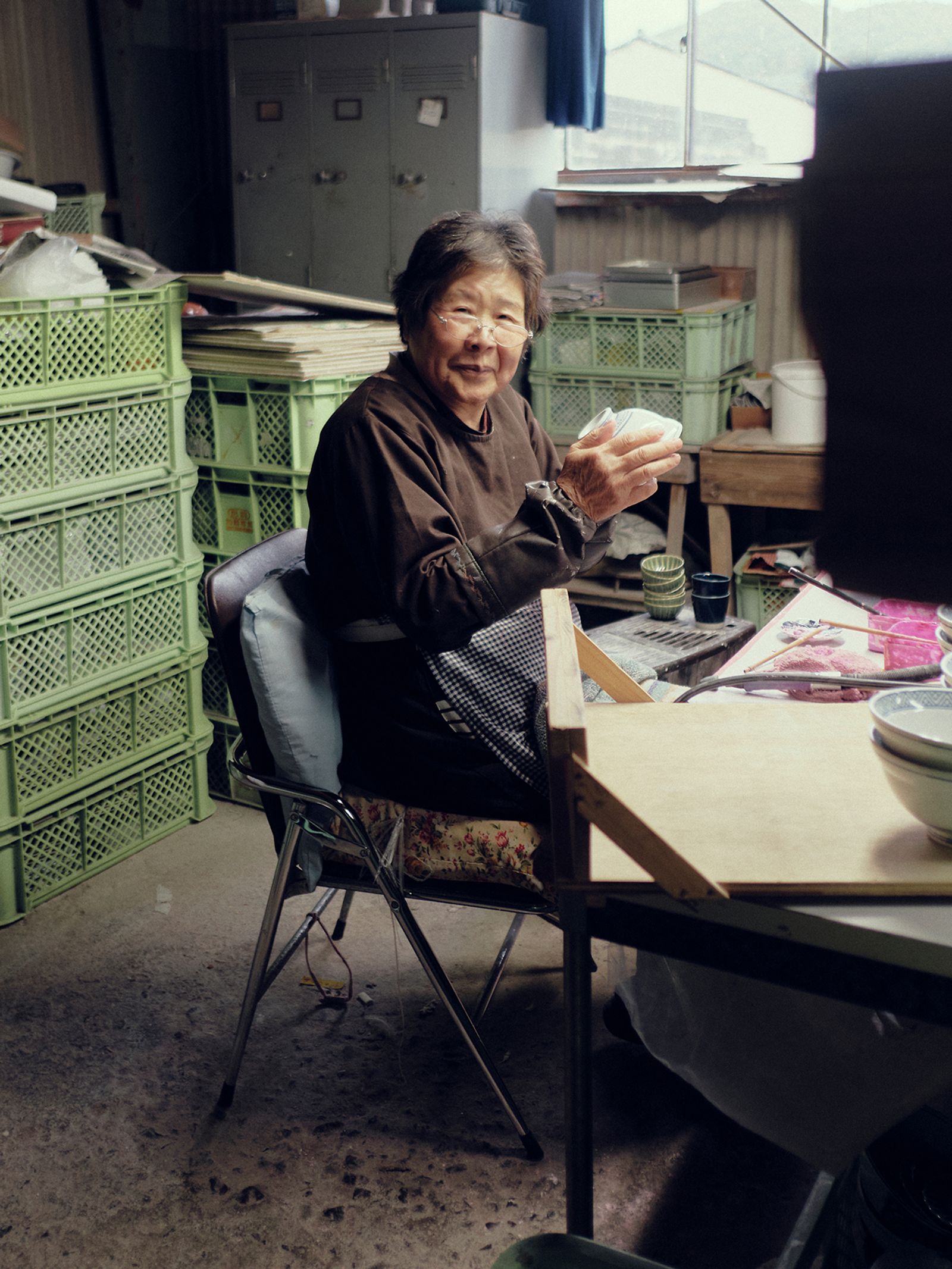
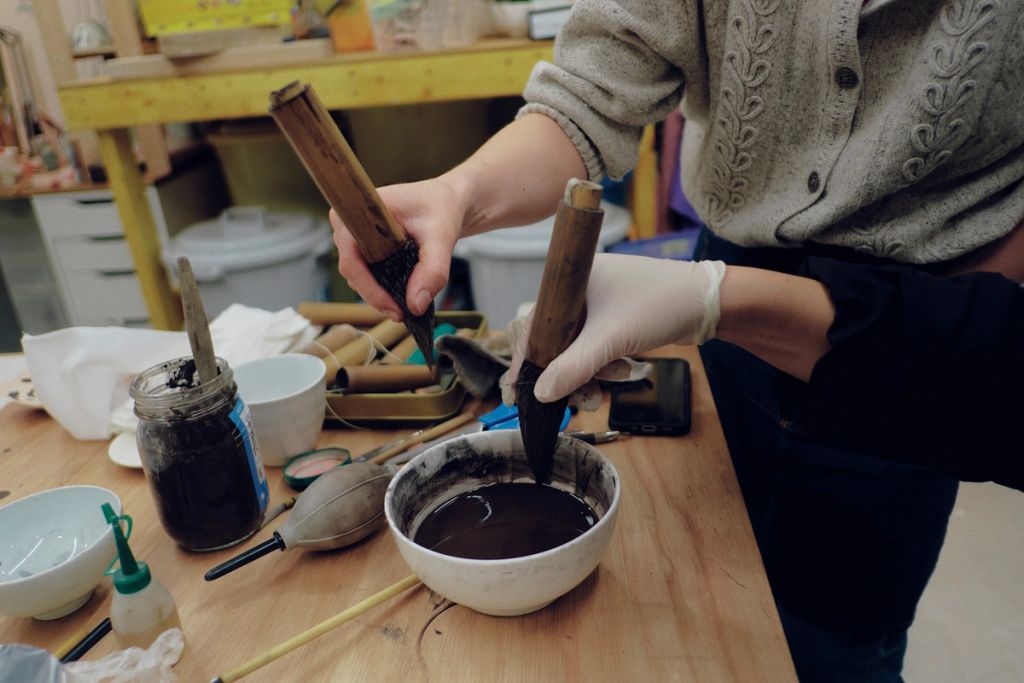
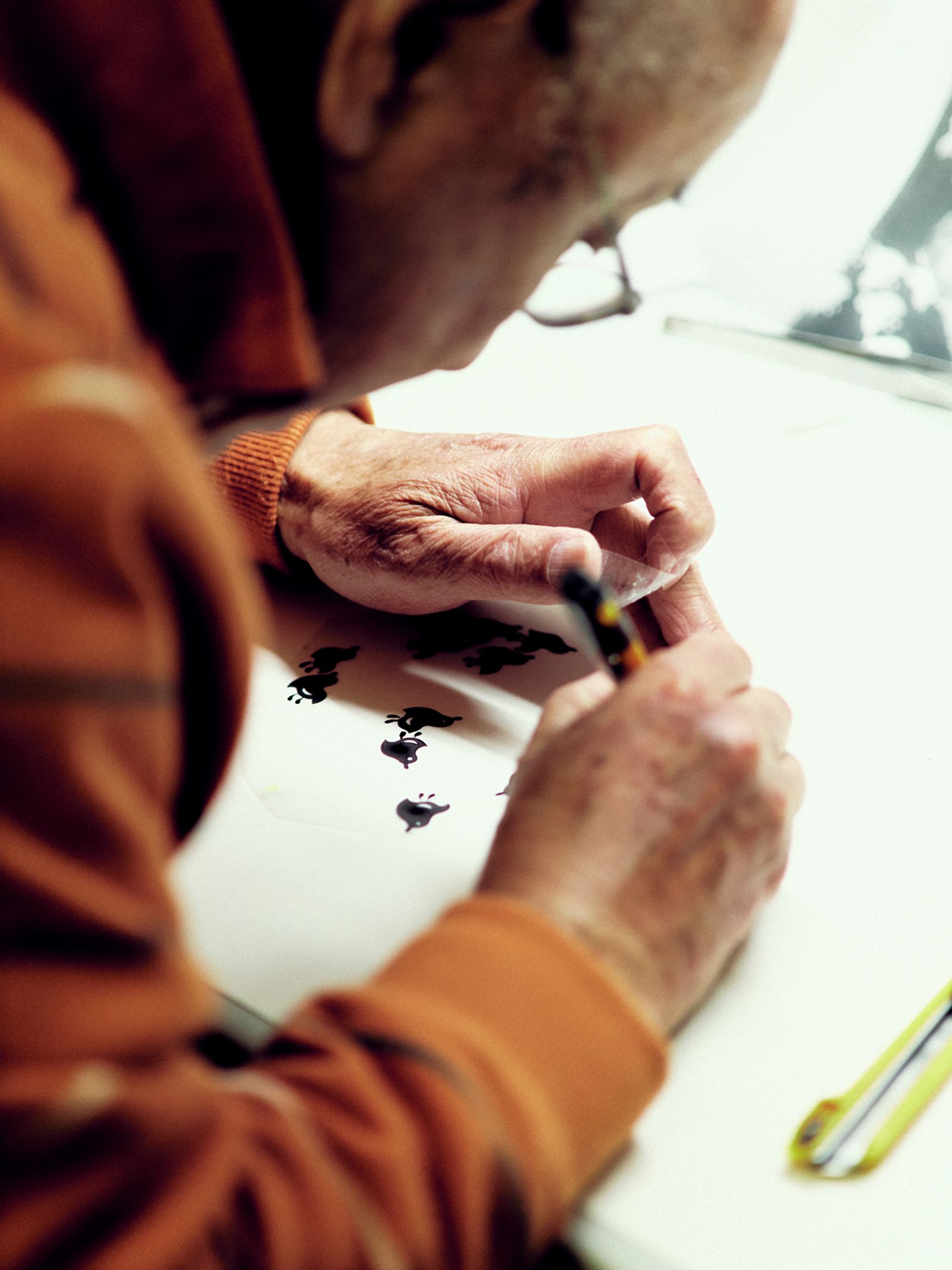
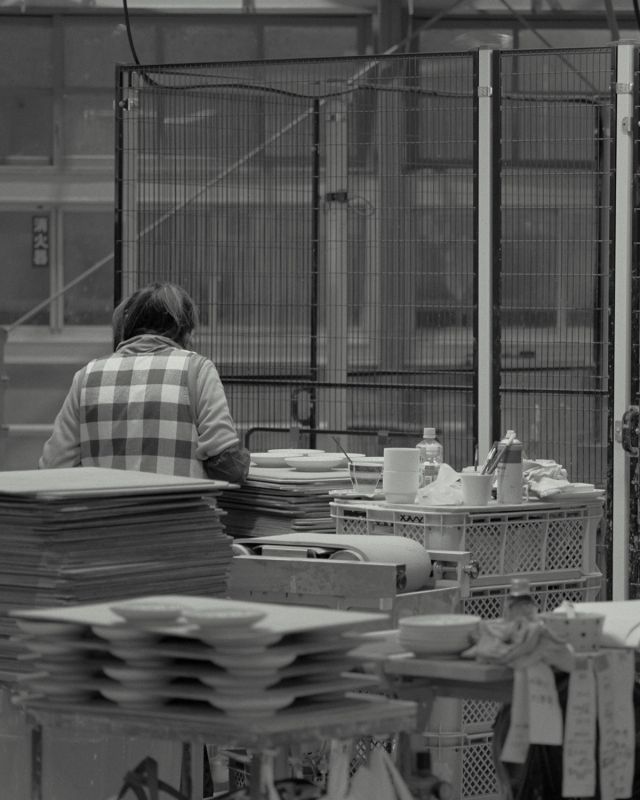
We met an old lady at Wazan, a kiln workshop in Hasami, working on the very last step before shipping the ceramics to distributors. With a bowl in one hand and a paintbrush in the other, she shifts the bowl around to see if there are any areas where the glaze has thinned or worn off. She applies the glaze by hand and fires it once again to avoid a defective product.
It’s a run-of-the-mill job, but it’s a necessary one. Call me crazy — I wouldn’t know where to start to program this level of care into a machine.
The division of labor has been a supportive ecosystem for the people of Hasami. While other ceramic towns relied on small numbers of individual artisans, Hasami established a collaborative system shared across the town.
The idea was simple: if everyone was part of the same industry, they might as well work together for a faster and wider production. This uniquely separated Hasami from other ceramic producing towns in Japan.
As mass production demanded speed, efficiency, and quality, Hasami was able to deliver on all three, with each stage of production handled by specialists devoted to their craft. Notably, neighbors were not competitors but partners, each responsible for carrying the work forward to the next phase of production.
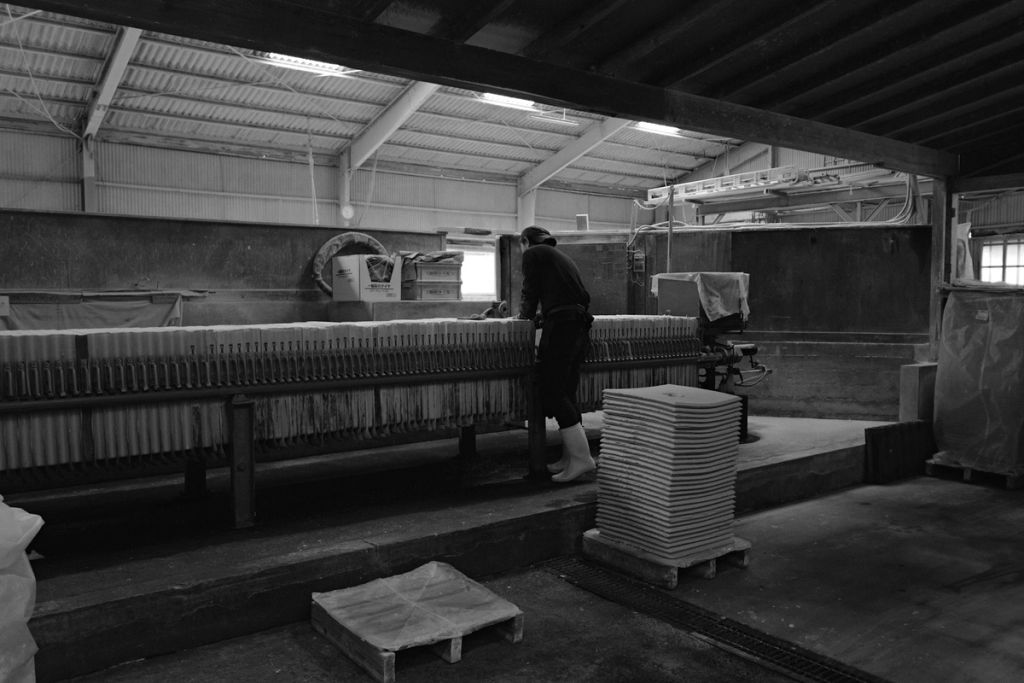
There were porttery stone polishers, migaki shokunin (磨き職人); clay suppliers, tōdoya (陶土屋); mold makers, kataya (型屋); clay body makers, kijiya (生地屋); kamamoto (窯元) who handled the firing; and uwaeya (上絵屋) responsible for painting and overglazing. There were even artisans dedicated to designing the seals pressed into each piece. Every step belonged to someone. Every role, however small, had its place.

I was surprised to learn that most of the processes behind the ceramic distributed as mass-produced industrial goods are, in fact, sustained by highly physical, hands-on labor.
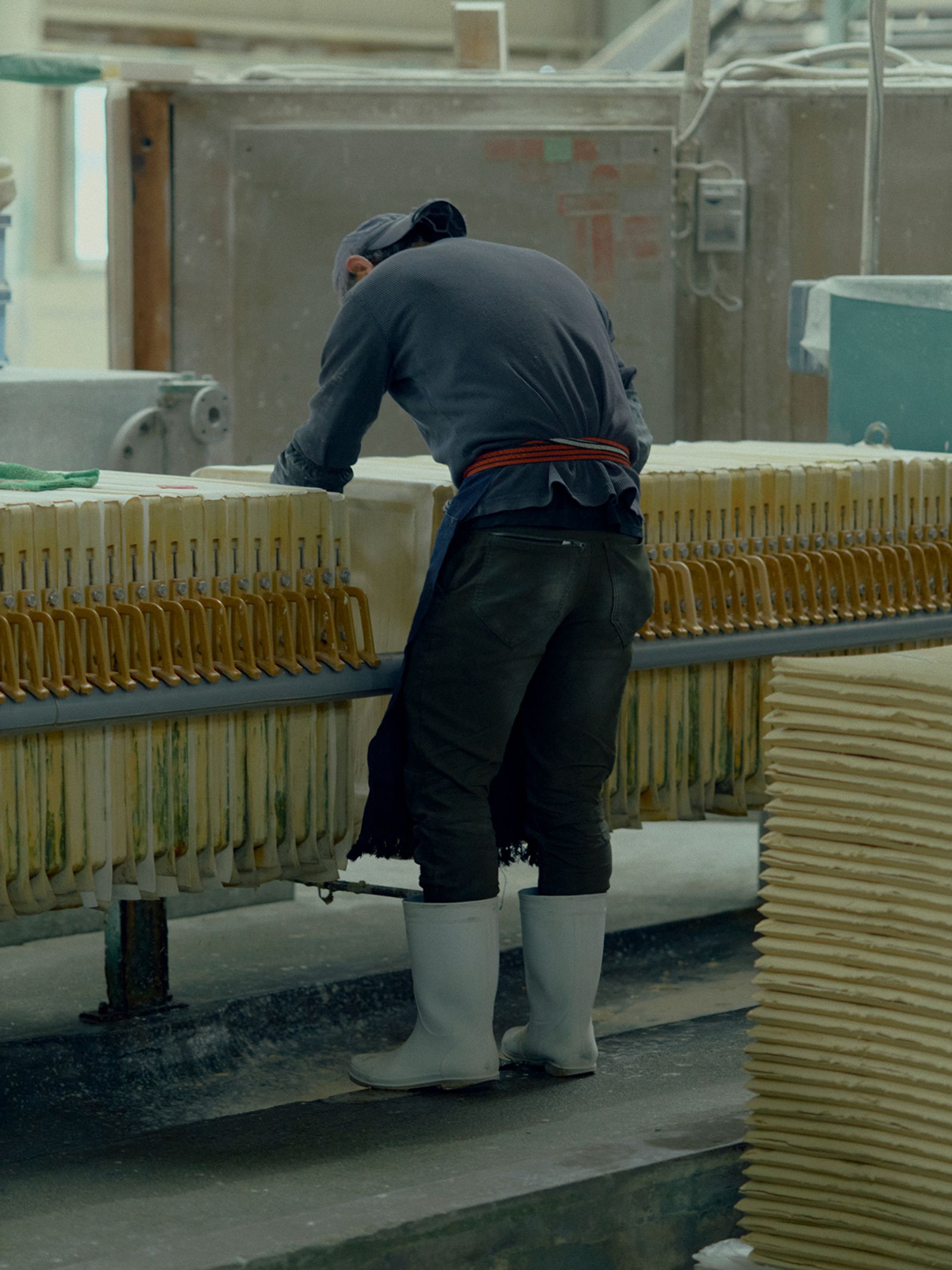
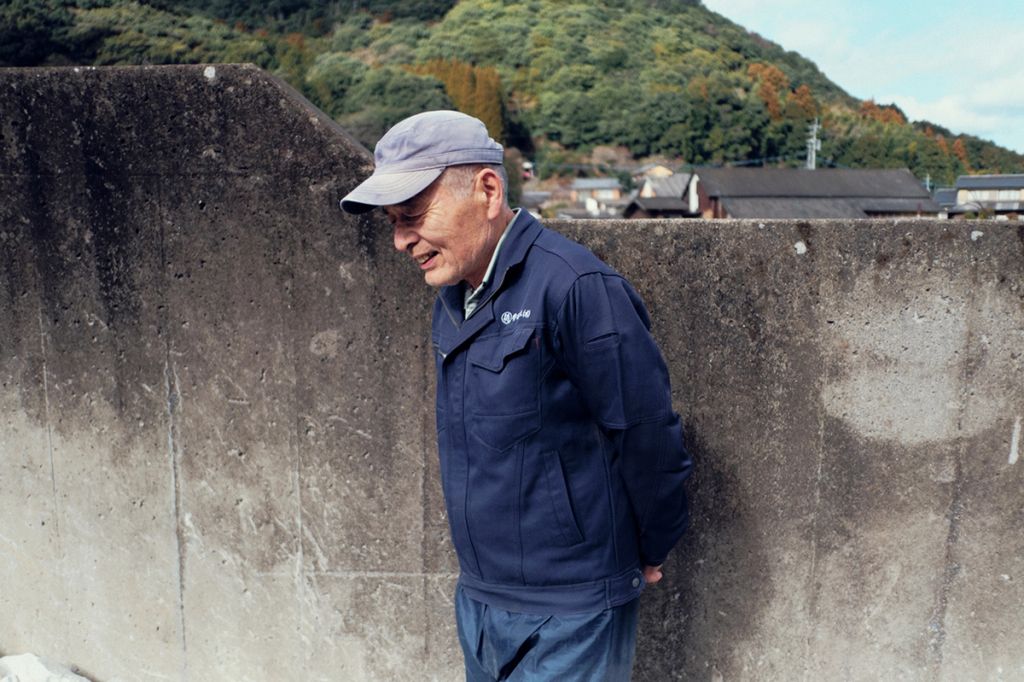
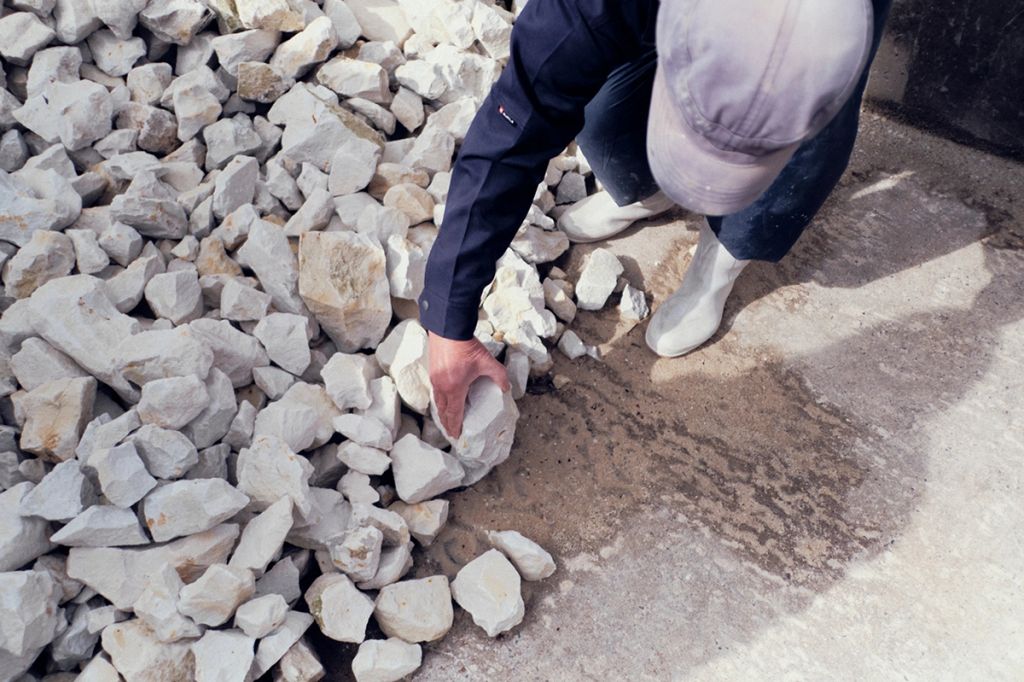
At an otherwise quiet site, we visited the clay maker Kōda Tōdō, founded in 1889. We heard a sound: clink, clink. A craftsman sat on the ground, carefully striking each stone with a small hammer, removing the reddish portions — traces of iron remaining within the white pottery stone.
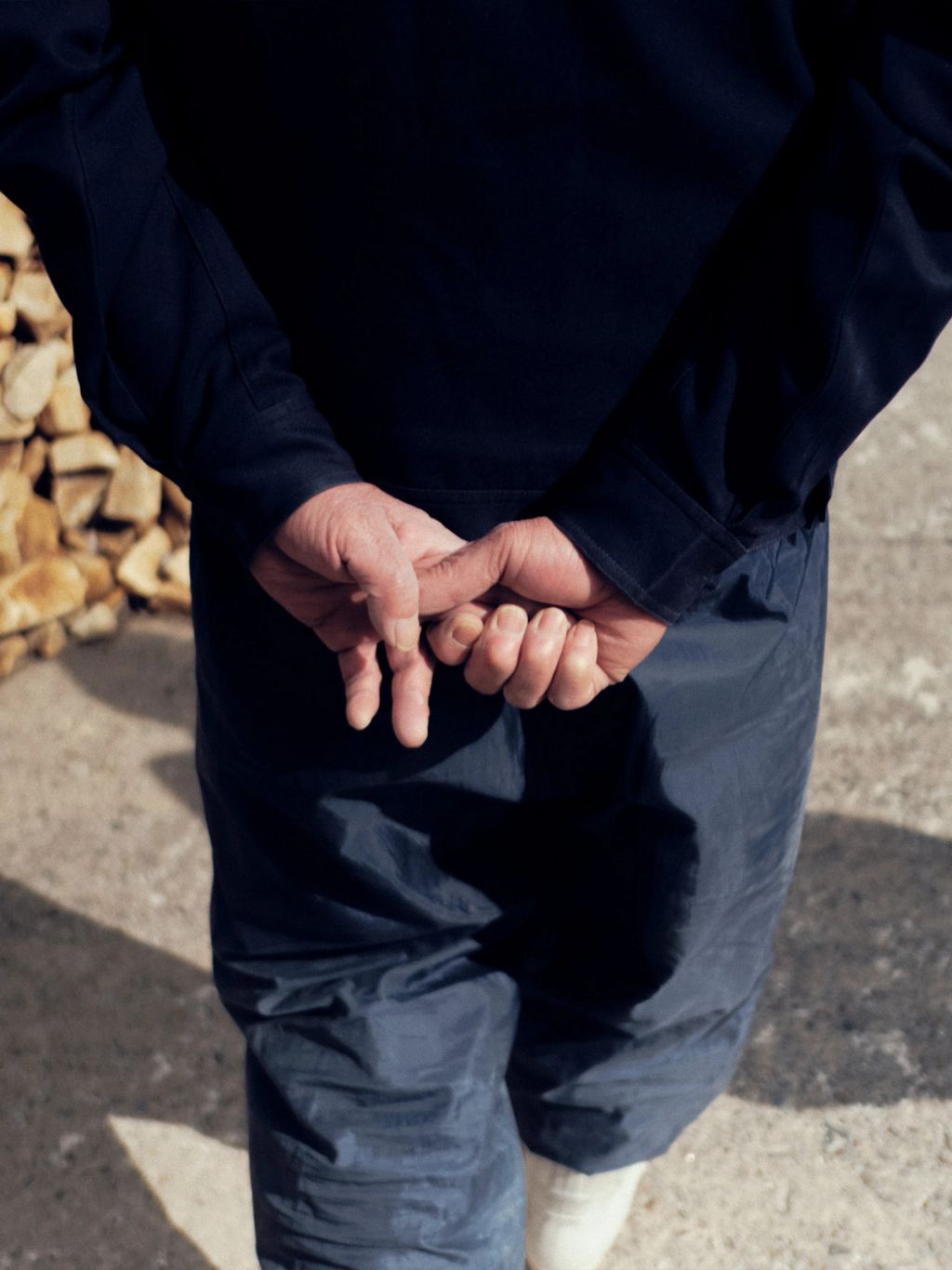
His name was Honda-san, his hands behind his back, shoulders hunched as he stood in front of the stone pile as he spoke to us. He was “polishing,” a process known as migaki (磨き). His skin, weathered by years under the sun, tells of the fifty years he has spent hammering the stone by hand since he was twenty-five.
As you can imagine, it is not an easy technique, under the scorching heat or the piercing cold. It’s also an extremely tedious and subdued line of work, not to mention a kind of work that has no manual or instructions; entirely dependent on muscle memory. In a world where the art of paying attention feels lost, Honda-san is hell-bent on his work.
The stone must keep the right size, ensuring that none of it goes to waste while determining exactly how much to shave away. A machine could never replicate the attention each piece receives by him.
“Why do you keep doing this job?” our photographer Jun asks. “I don’t know… I guess it’s fun,” he mutters under his breath.
Later, the clay maker owner Kōda-san told us reluctantly, “He’s the only person left who can be that precise.”
While the idea of specialized work creates high quality ceramics in which it positions Hasami a strong traditional craft industry, it also makes it a vulnerable one as well. Everyone has an extremely specialized and particular role that only a certain person can perform,which also makes an industry fragile. As most people in Hasami are dependent on the ceramic industry, if one part falls, it affects the other parts as well. As of today, there are still people that are capable of doing the job, but what happens when they are gone?
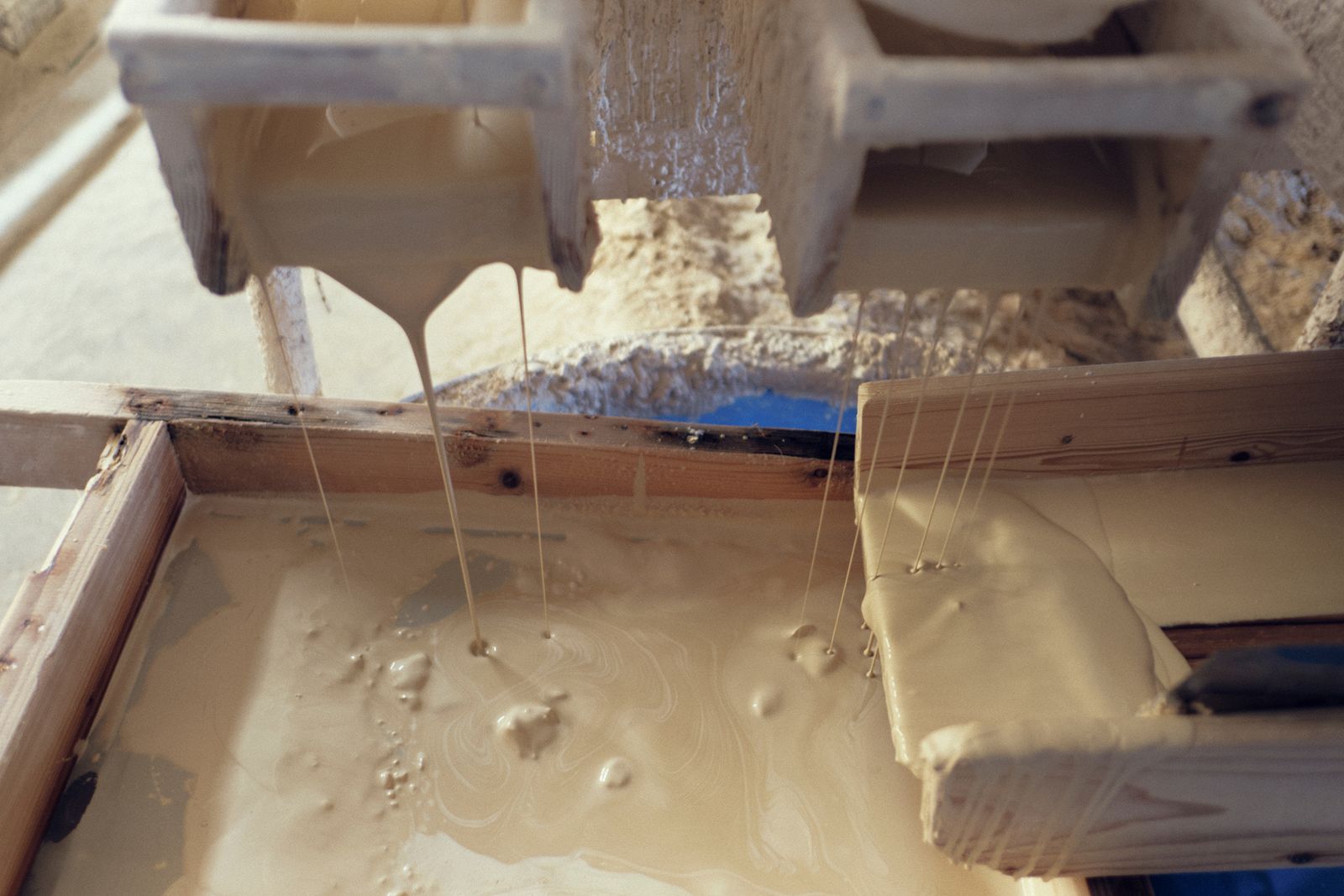
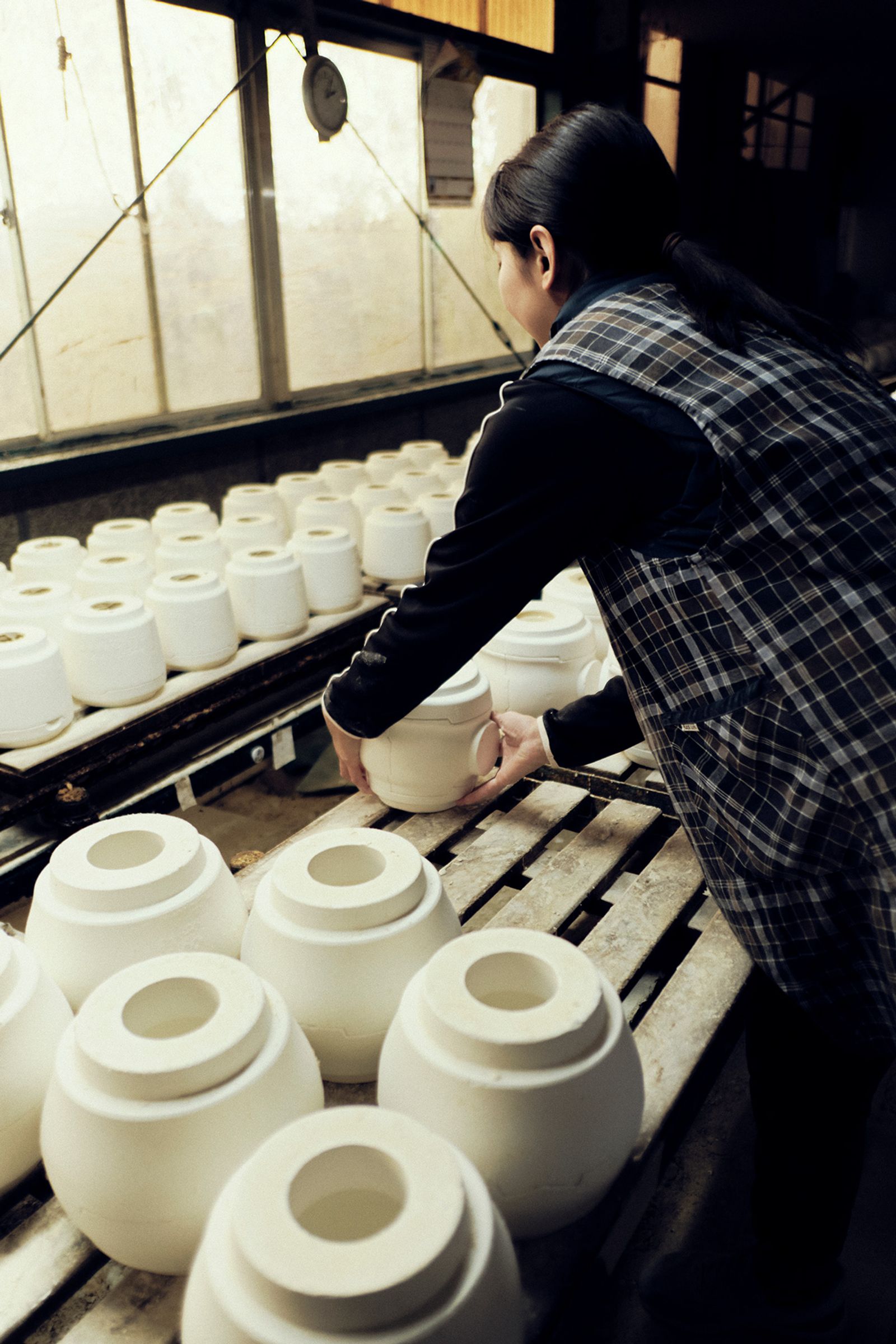
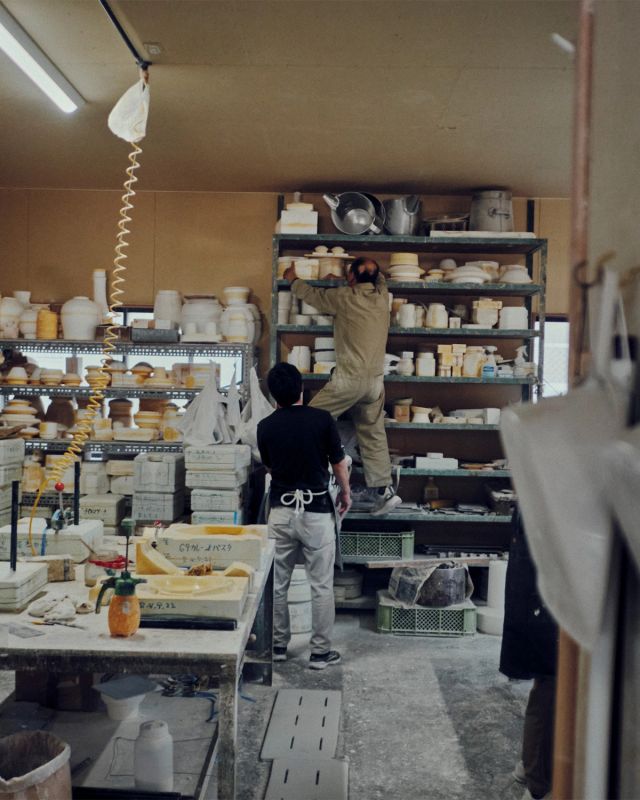
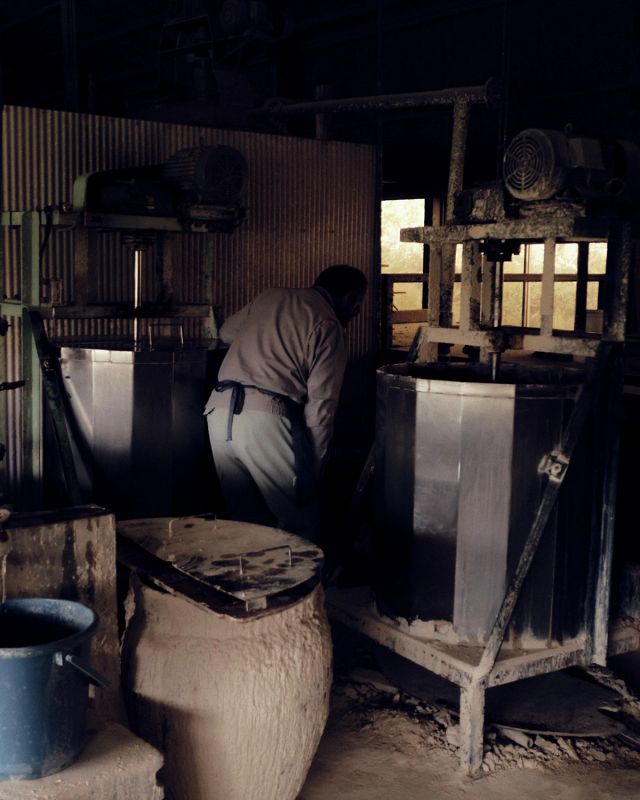
At a clay body maker factory, a woman named Arisa-san was working on slip casting. Jun asked her, “If I were to start learning slip casting today, where would I begin?” She paused, slightly unsure by the question, as if there was a manual to this line of work.
“You have to start by learning the thickness of the clay body,” she said.
Jun asked how someone learns that.
“It’s a feeling… I suppose,” she said, pausing again.
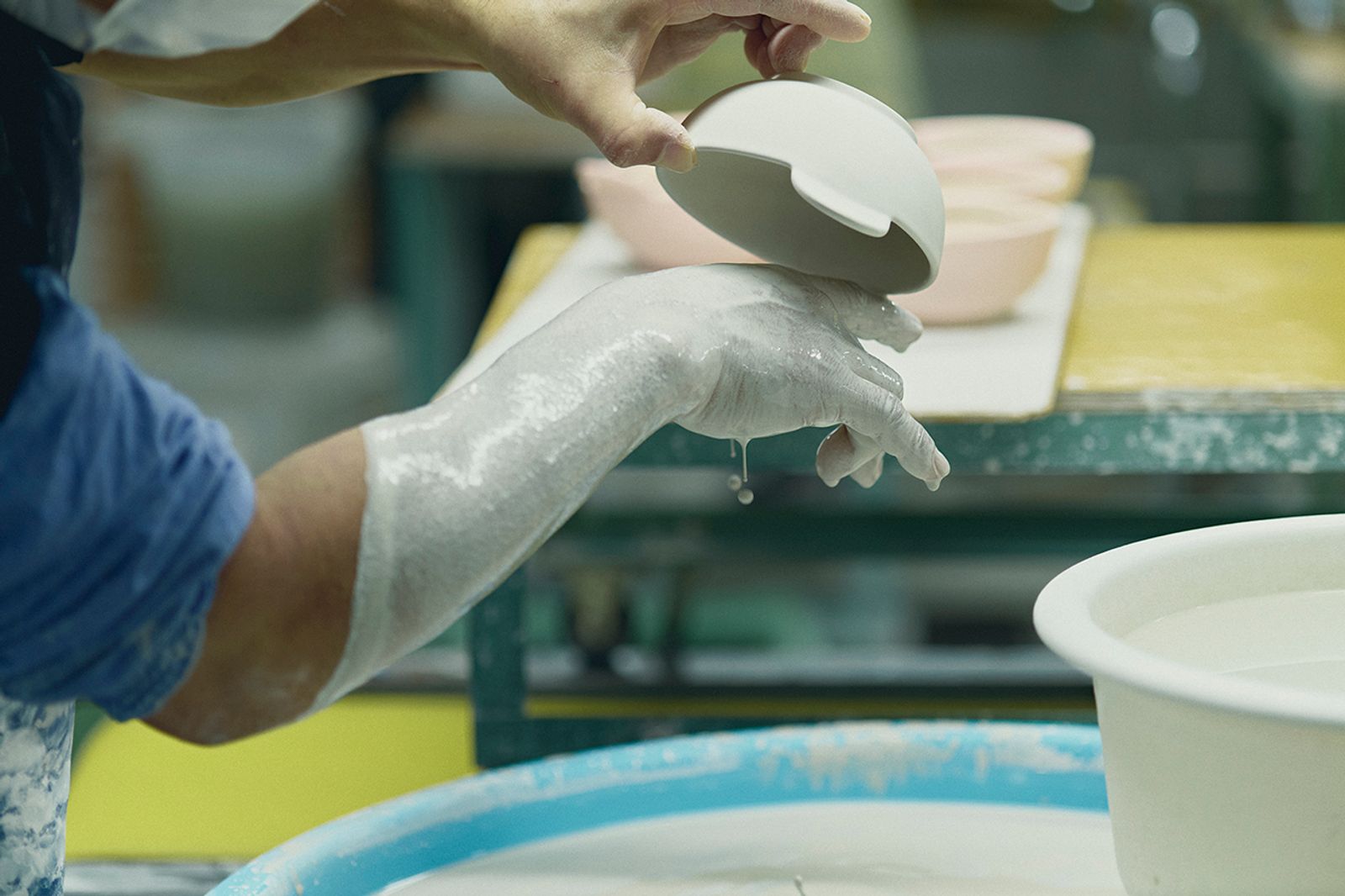
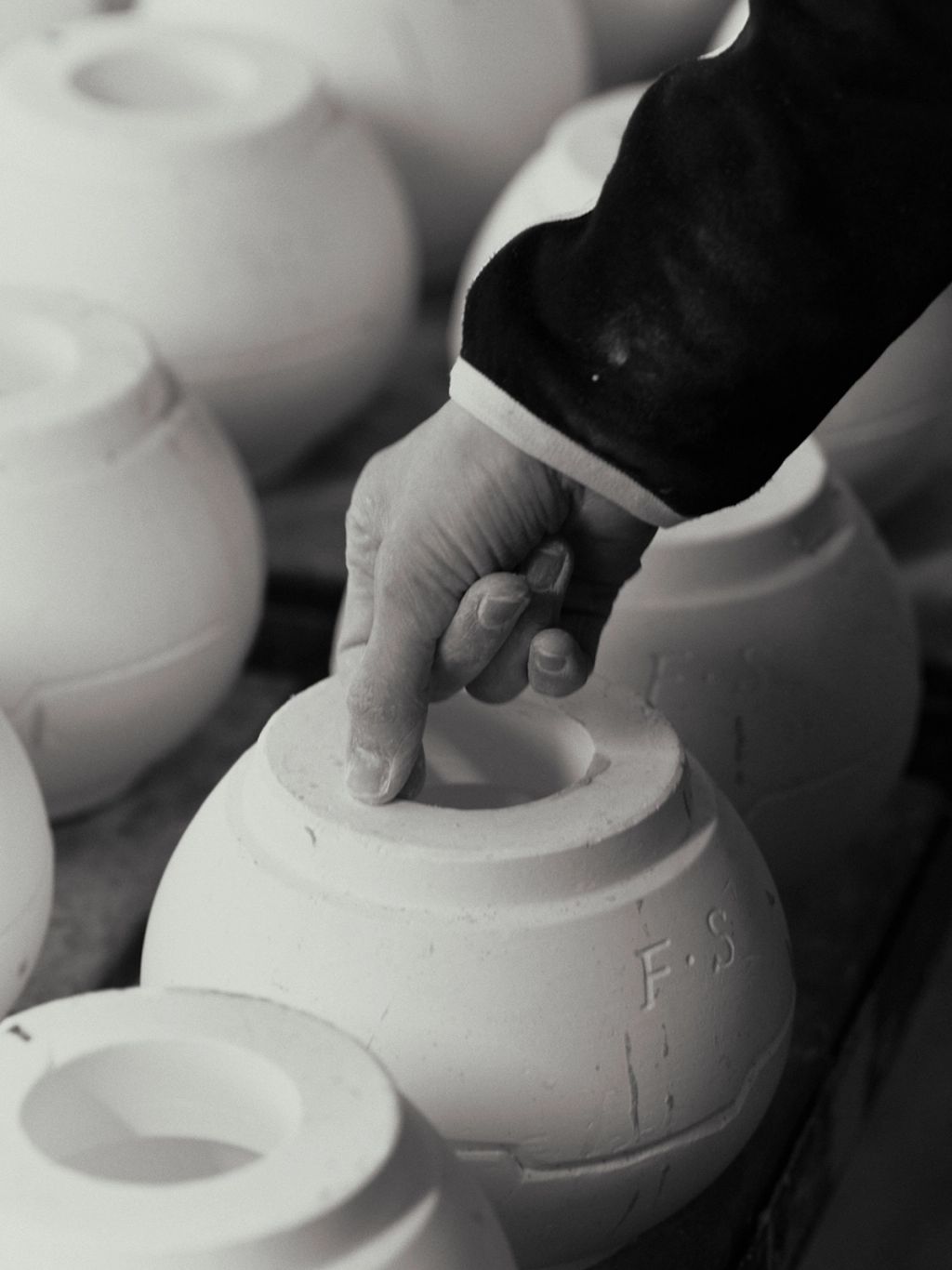
We watched as she poured the liquid clay into the mold. There was a rhythm to the way she worked: dump, wait, swirl, flip; dump, wait, swirl, flip. She didn’t need a watch or a timer — only years of experience guided her forward. She instinctively understood how the required thickness changed from one mold to another. Later, she told us it had taken her five years to master slip casting on her own.
Img. 01
Img. 02
Img. 03
Img. 04
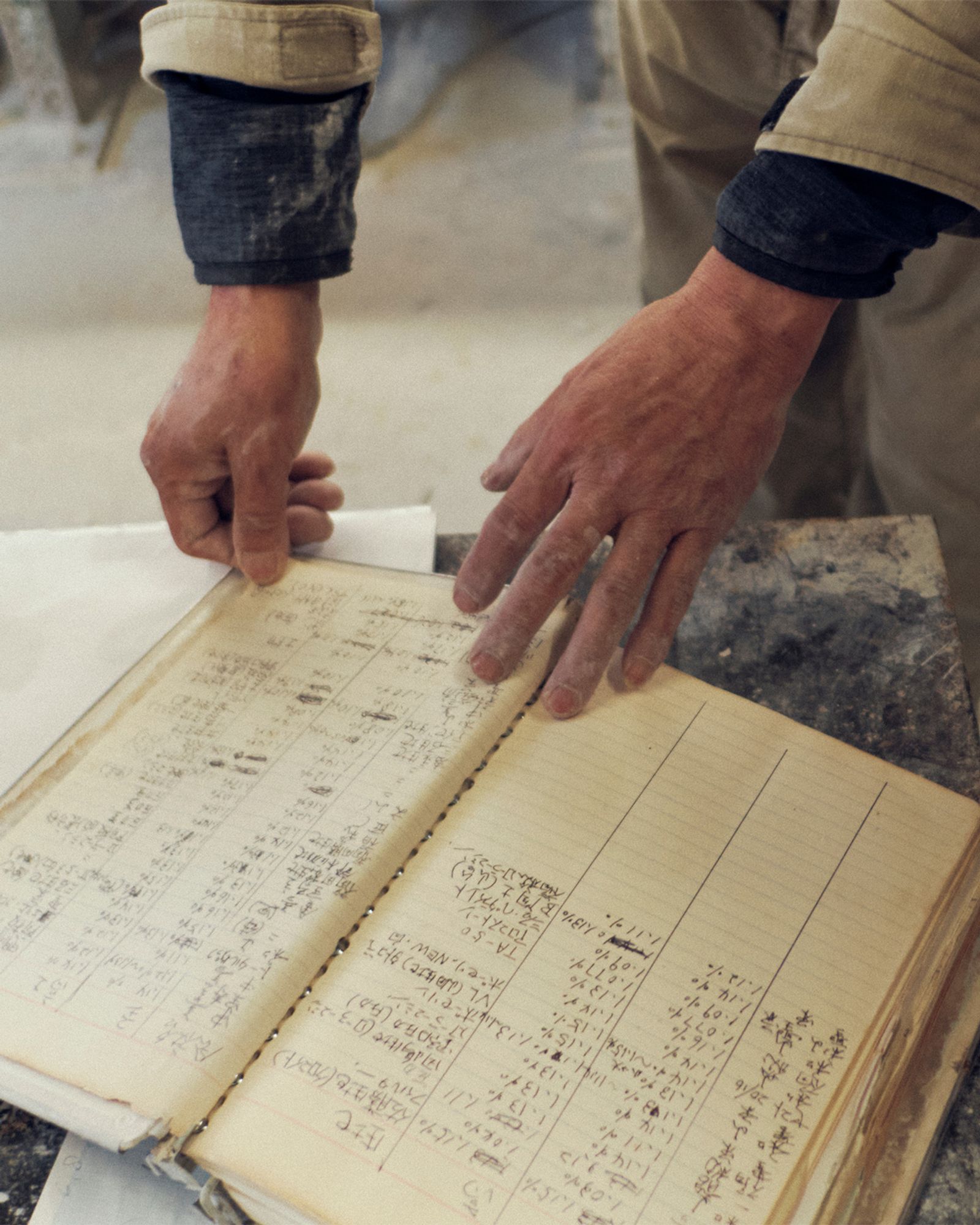
Fukushima-san runs a mold making factory. He flipped through decades’ worth of notes that only he seemed to understand. It was a pencil-written notebook documenting the shrinkage rate of every mold he handles at his factory.
“I’ve recorded how the shrinkage changes depending on the kiln and the clay,” he explained, “so I know what size to make the molds.”
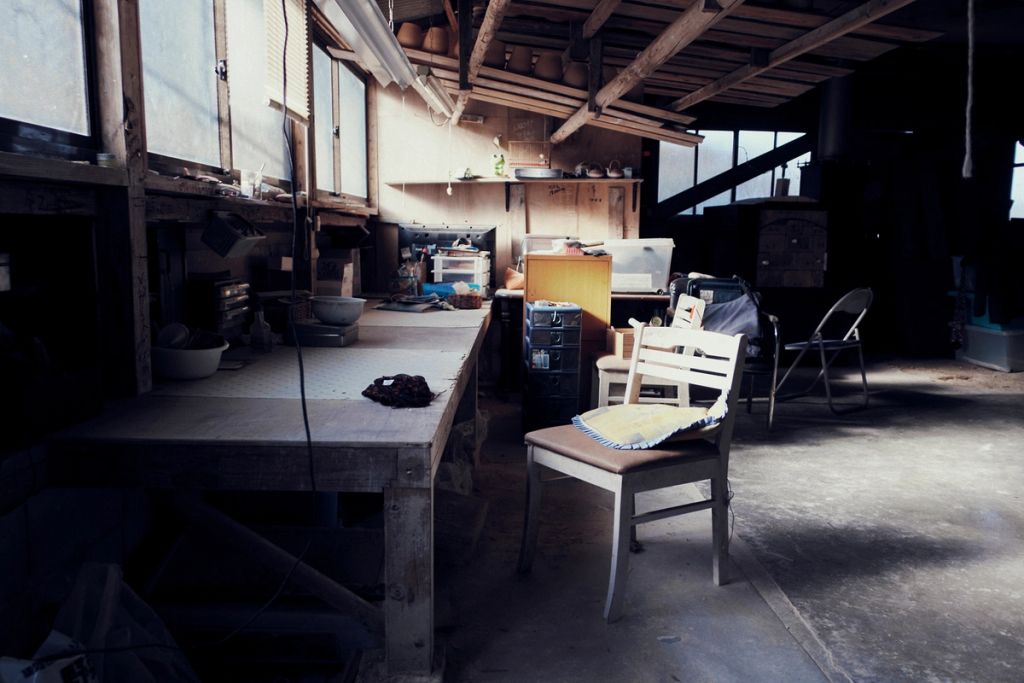
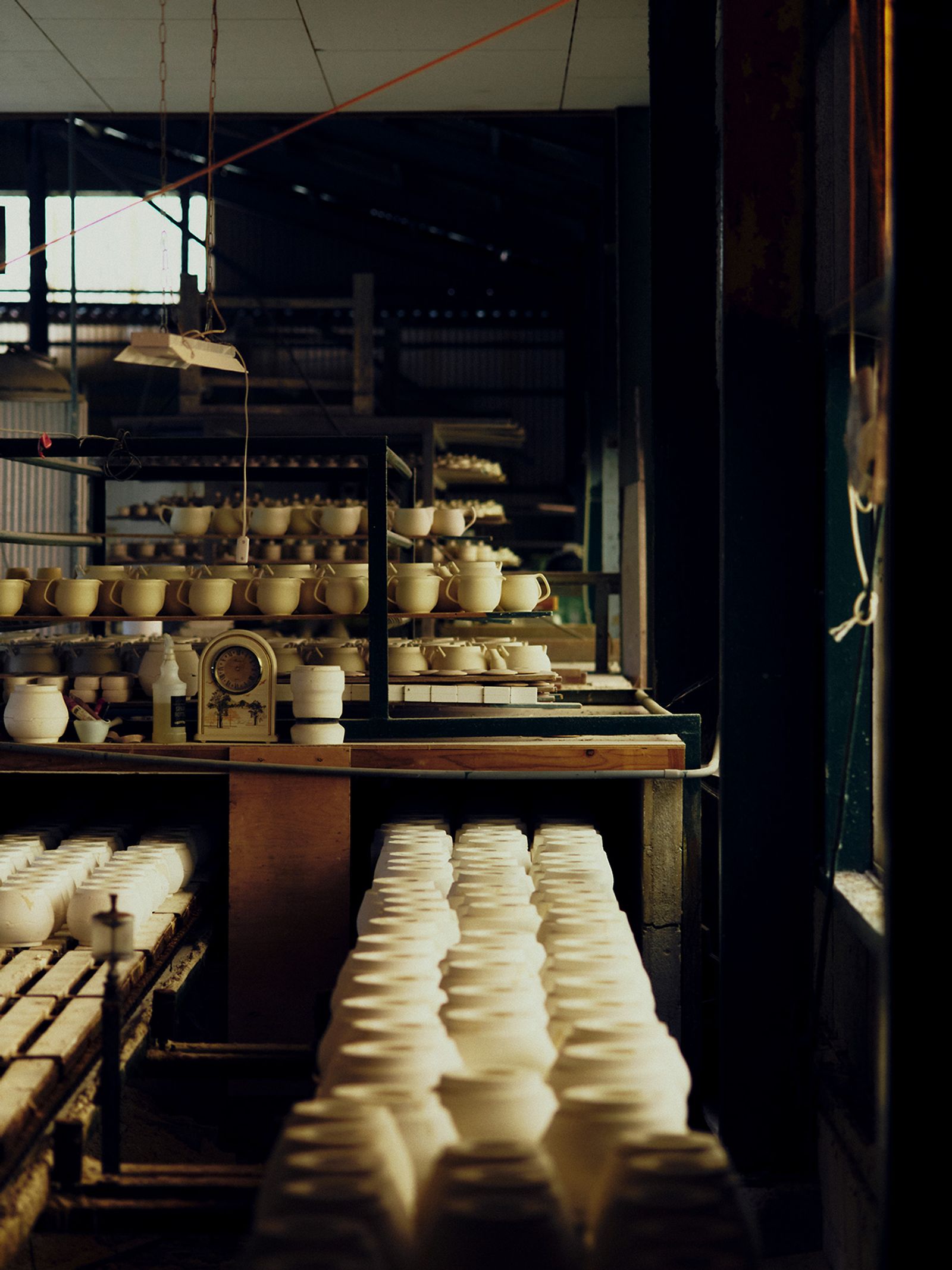
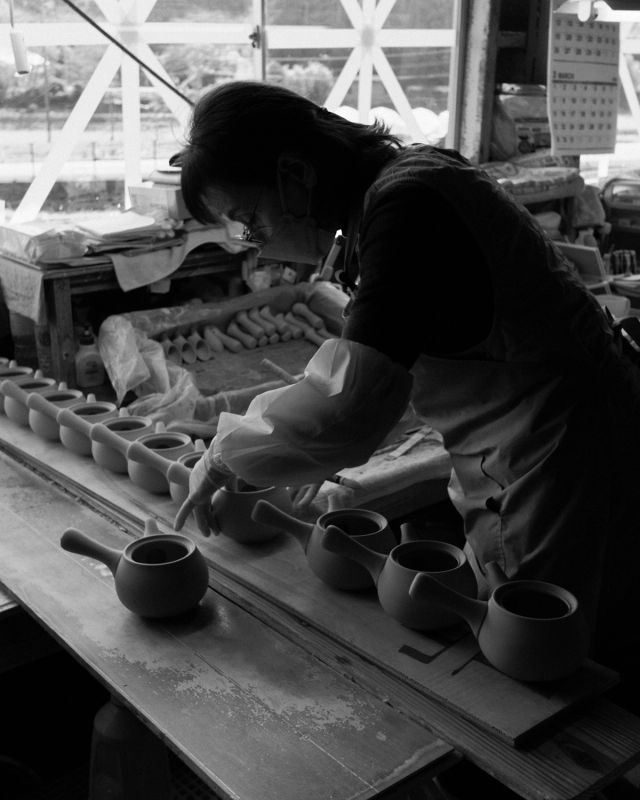
In another workshop, people sat side by side at their desks — occasionally interrupted by a cat weaving between their finished pieces. Each had a hot flask beside them, a lamp of their choosing, and a chair with a flattened cushion carefully placed. Their movements, almost identical to the ones before them, stop my steps; you could easily lose yourself watching their technique. After years of routined work, their movement is second nature to them.
There are many reasons why communal work is meaningful to the individual. It builds trust among people, and the work and craft become the glue that binds them together. From a business standpoint, success doesn’t belong to one person; it belongs to everyone involved. Conversely, the ecosystem in Hasami can only function if everyone is working in tandem.
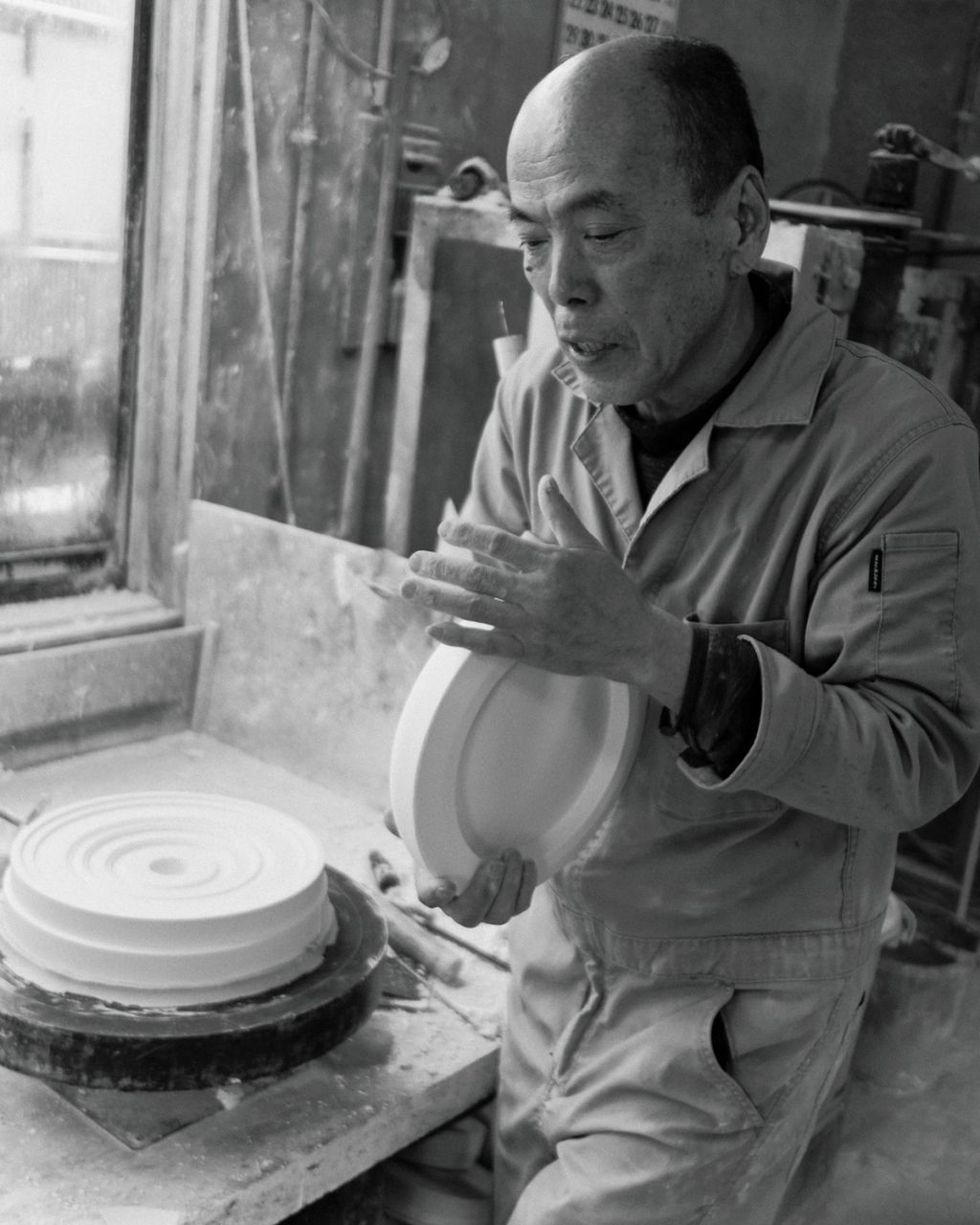
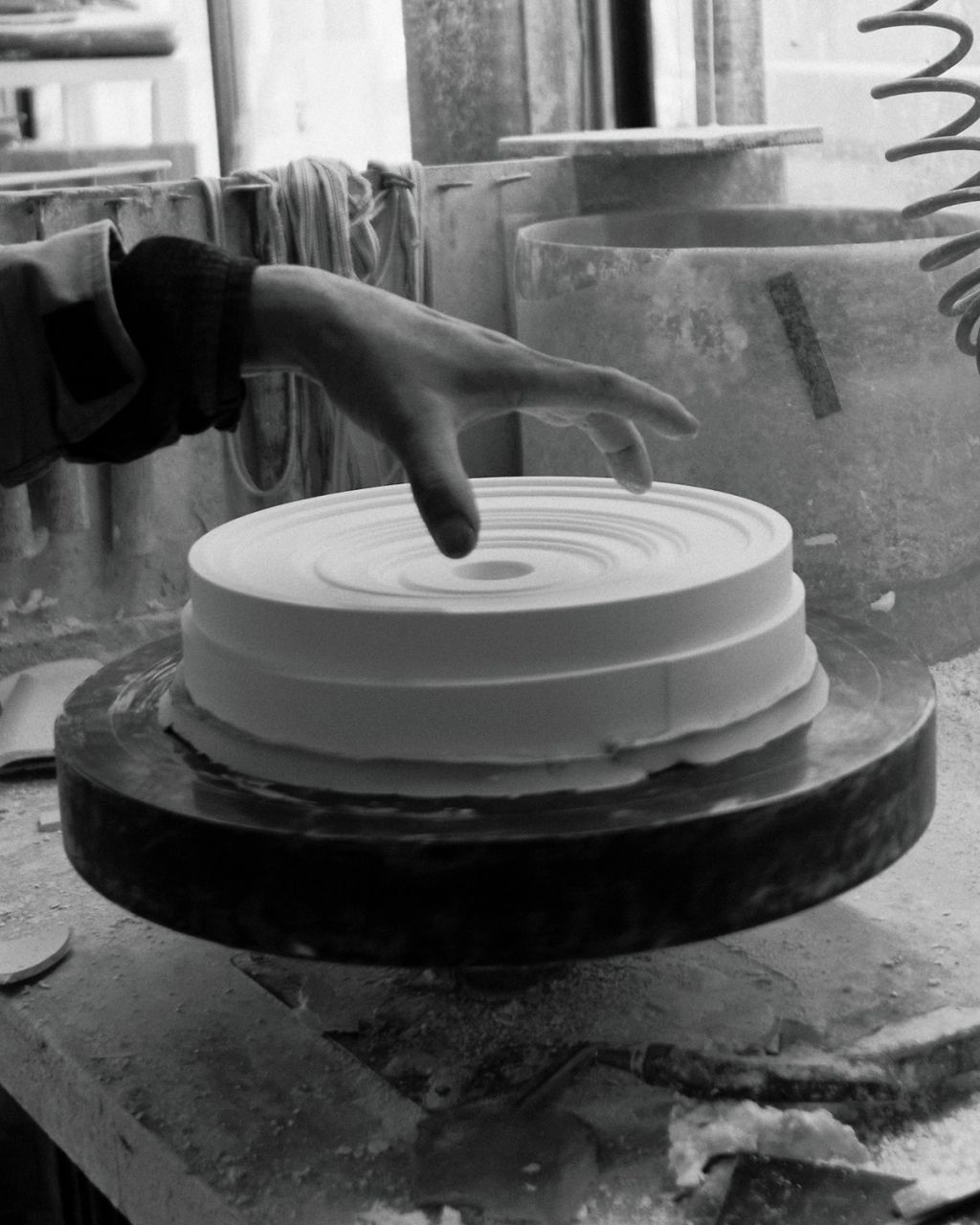
What makes Hasami strong is also what makes it vulnerable. In a town where each role is carried by only a handful of people — sometimes just one — the loss of a single link can put the whole chain at risk.
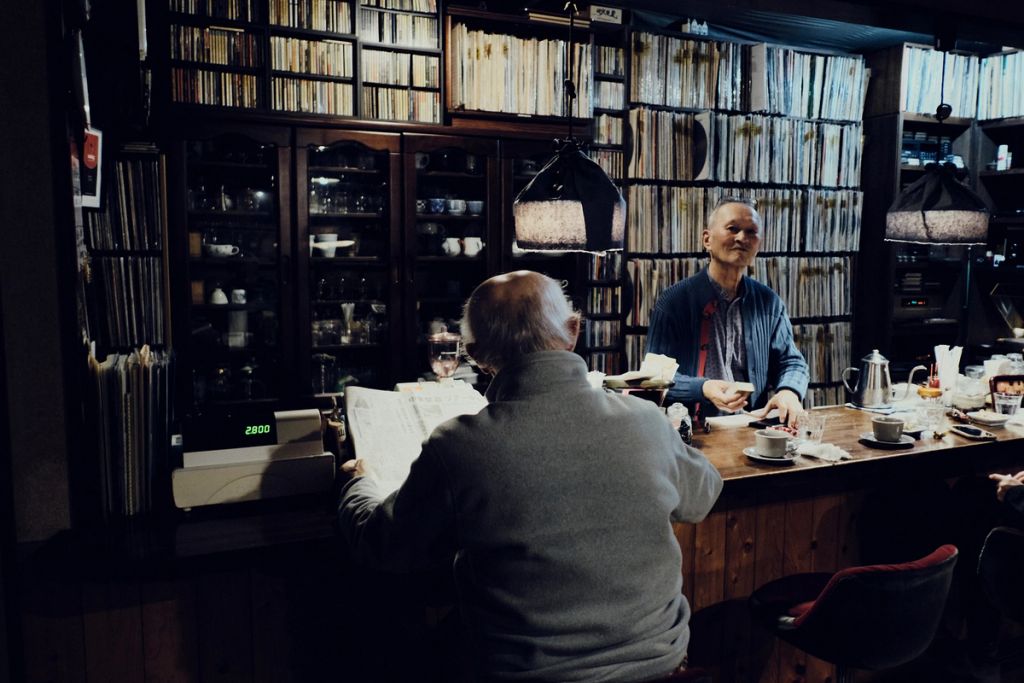
We went to an old jazz cafe called Doug, run by a snazzy eighty-year-old man, Masato Tateishi-san. He is the last standing seal (hanko) designer that also runs a cafe.
People told us that almost every stamp design you see on plates from Hasami was made by Tateishi-san. I spotted one at Wazan — a yellow mimosa carved by him. I traced the mimosa with my fingers, thinking about the person behind the design.
Later, Wazan's president told us that he wouldn’t know what to do when Tateishi-san is gone. “There are textures, patterns, a certain feeling that only a hand-carved stamp can create," he said almost wistfully.
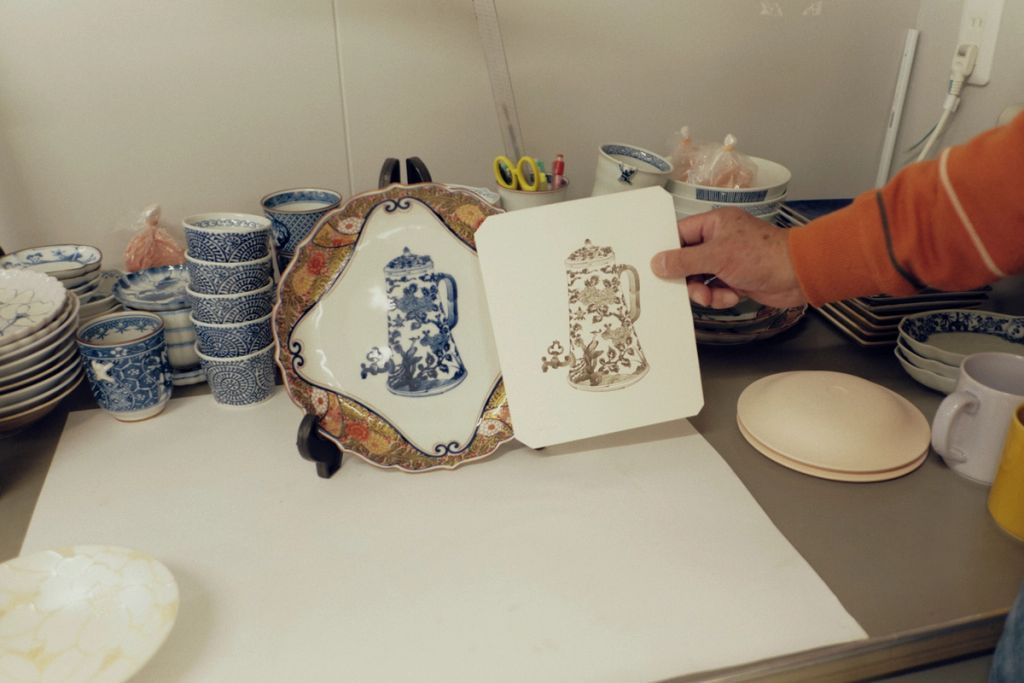
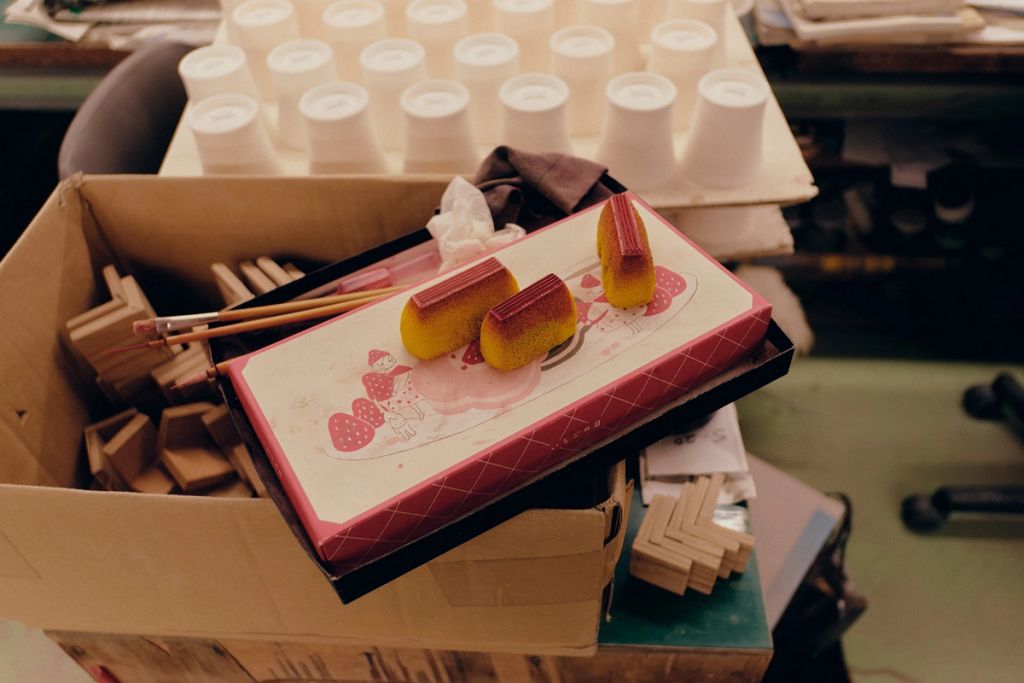
The same worry runs through other factories and workshops as well. Fukushima-san, the mold maker, has a two-month wait for new orders. The whiteboard above his desk is marked in red throughout May, with due dates and to-dos written all over it. Across Hasami, there are only around ten people capable of making molds at his level, and most are significantly older than Fukushima-san.
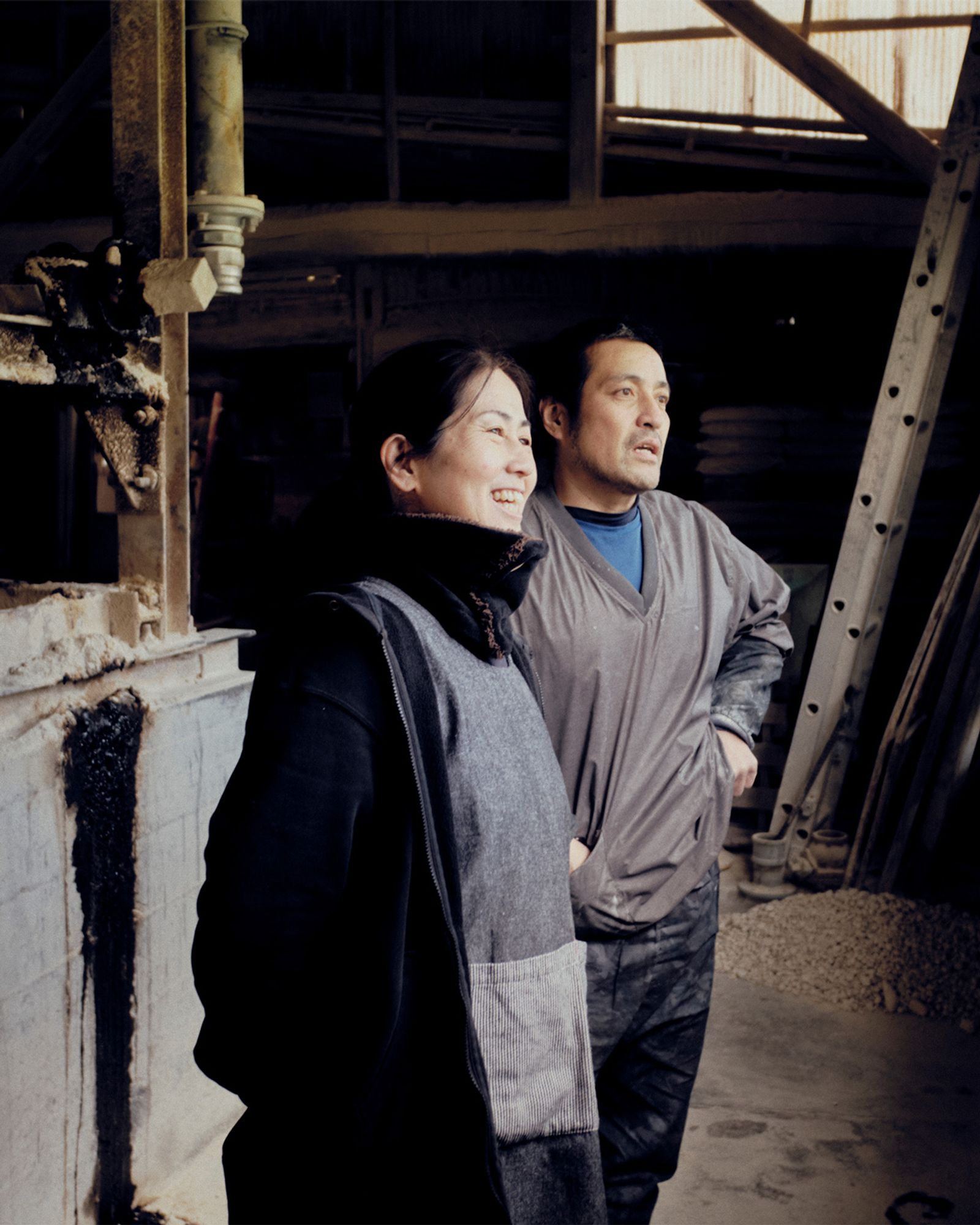
A couple running Nishino Tōdo, a 130-year-old clay supplier, said they have lost more than half their clients in the past decade, and told their three children not to take over the work, describing it as physically demanding, financially unstable, and offering little job security.
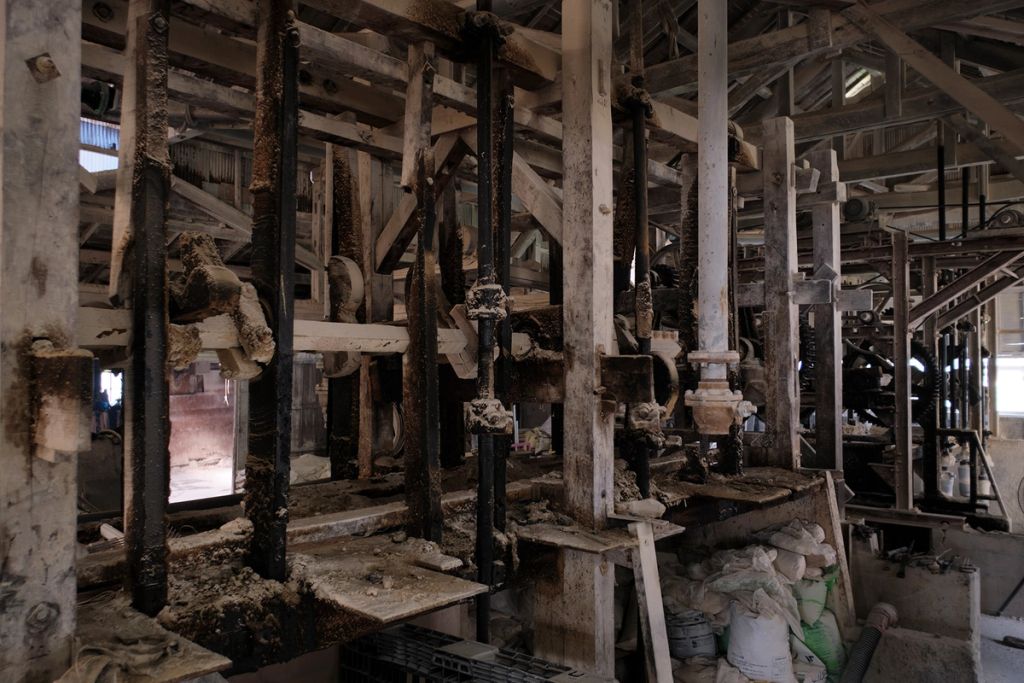
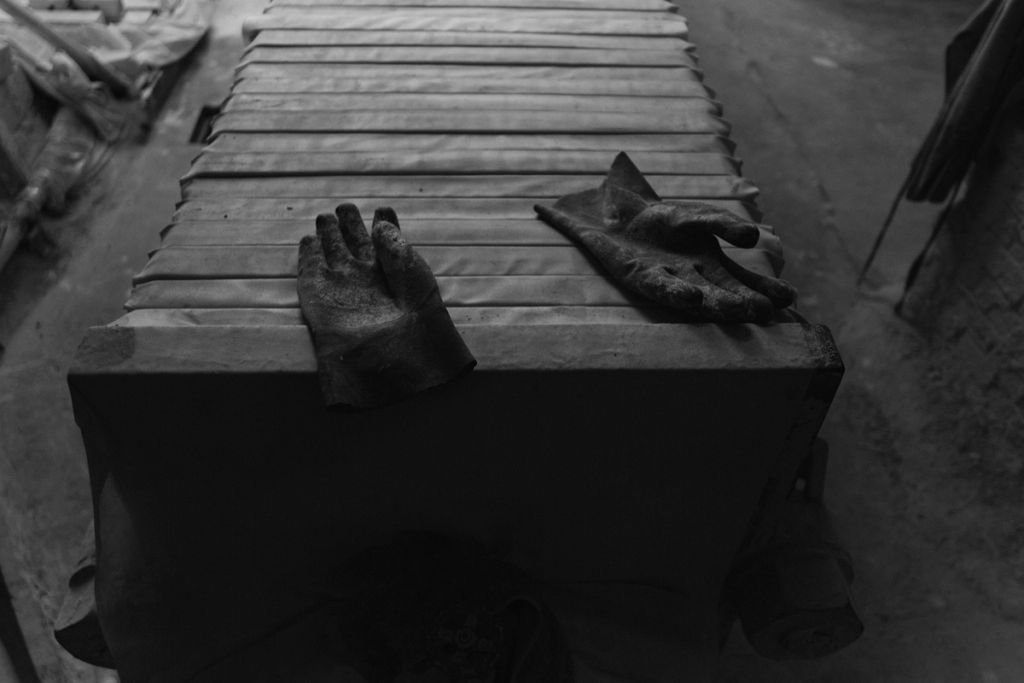
These aren't just stories of an aging population or succession, but it is the symptoms of how the entire system is interconnected—and it’s not as simple as changing the system overnight.
The rising cost of pottery stone has been a growing concern each year, due to the shortage of people mining in Amakusa, where nearly 80 percent of Hasami ware is made using it. Hasami ware has always been sold as everyday tableware—affordable, accessible, a staple of Japanese households—making it difficult to simply pass those rising costs onto the price tag.
Switching to alternative materials might seem like a way out, but as the president of Saikai Toki, a local trading company, explained:
“Even if we try to switch to another material, everything—from molds and glazes to firing methods—has been developed to match the specific clay we use. The entire town would have to change at once. It's not realistic.”
Hasami now stands at a crossroads: raising its prices, reshaping its identity, or finding and building a new community to become more resilient to the status quo.
There is a risk that knowledge and skill are dependent on a single person, and the economy is also reliant on each other, but because of this, there is also a noticeable culture that is unique to Hasami: everything exists together in the effort of nurturing one another.
The relationships between people, and between people and nature, are deeply interconnected—interlaced in ways that feel both lived and intuitive. We saw this in the people we encountered. Despite the town’s relative seclusion, the people of Hasami were willing to open up, welcoming strangers that felt sincere.
The Hatanaka couple, who run a community hub in Nakaoyama—once a pottery workshop, now renovated by locals into a community hub—embodied this spirit. There was nothing performative in their hospitality, no sense of pretension, only a quiet generosity.
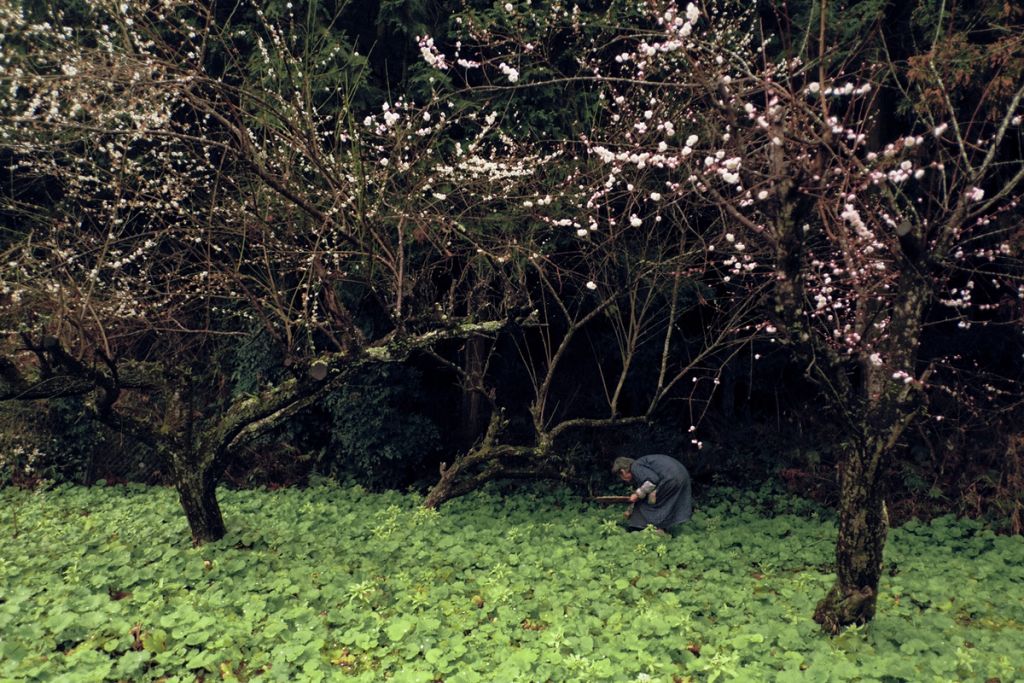
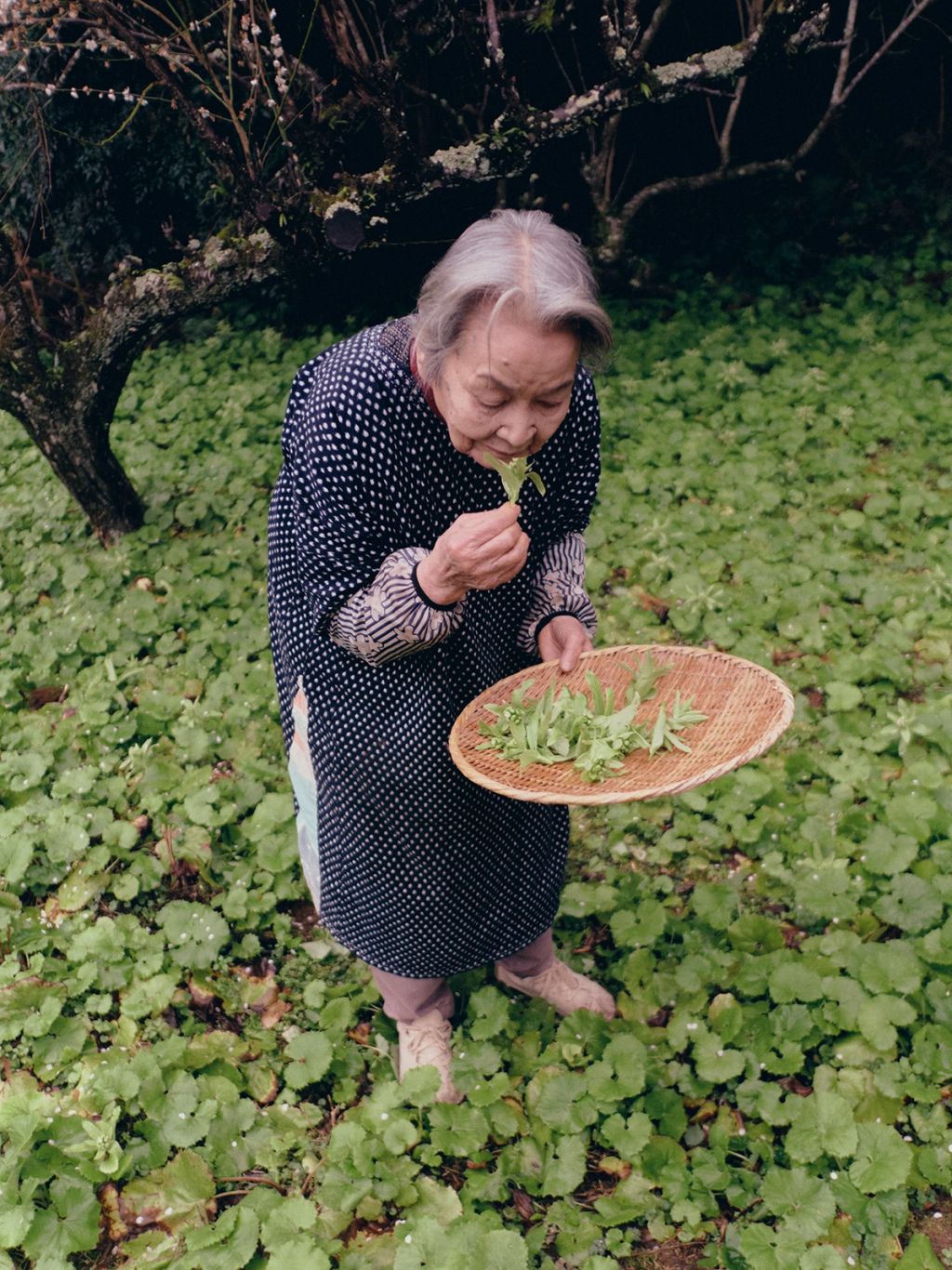
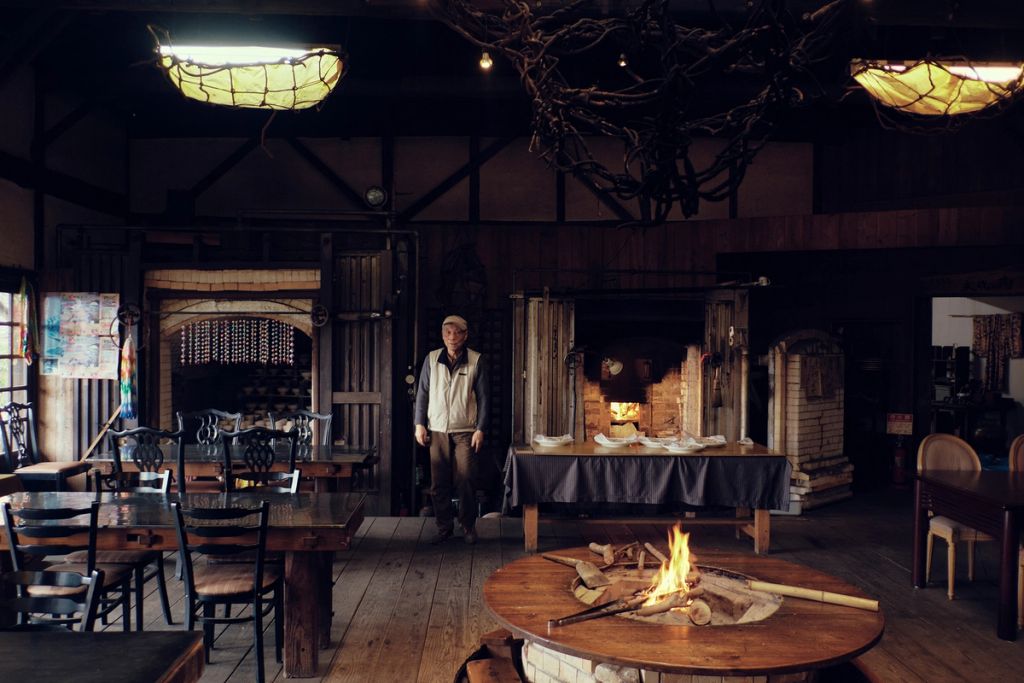
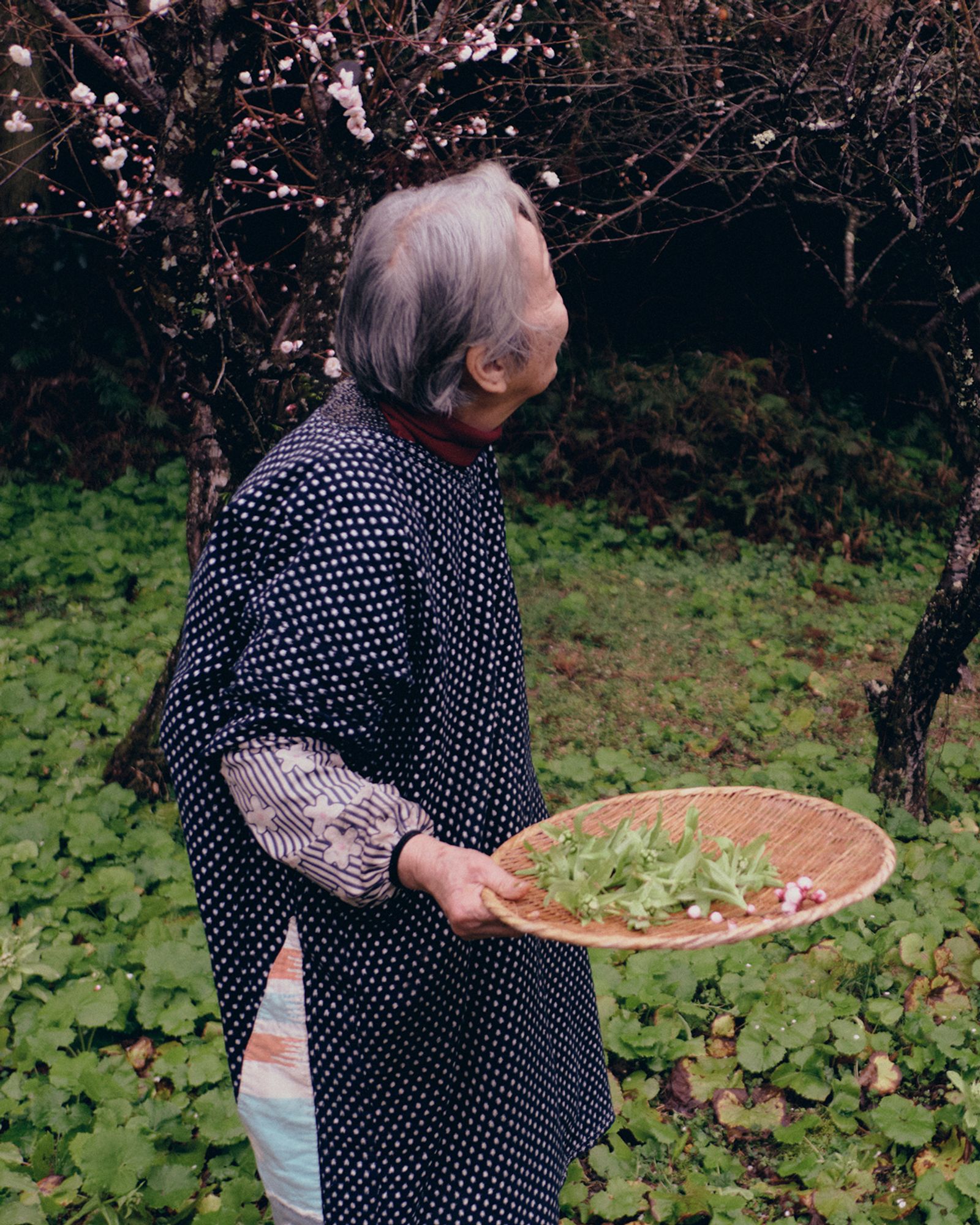
“Come, come! Look—there’s fukinoto. I’ll fry it up and make tempura for us.”
Mrs. Hatanaka crouched beneath a budding plum tree, her eyes bright as she smiled at us. Soon after, they baked pizza for us in an oven made from a repurposed kiln while sharing stories after stories.
We learned that Hasami cannot exist without its people, and this struck a chord when we were speaking to Kobayashi-san about the succession of his ceramic business.
“More than the business, I want my children to keep the rice fields going. If no one takes care of it, the land will be left untended and abandoned,” he said.
It felt like this came from Kobayashi-san’s intrinsic understanding of how things are bound together in Hasami. Nothing—even agriculture and nature—can exist on its own; it must be preserved communally.


So, what does preservation mean for Hasami? The people of Hasami have given us some clues to reflect on. As Kobayashi-san said, perhaps preservation or inheritance isn’t necessarily about the technique itself, but rather about how to sustain and support the connection within the community.
The old lady we met at Wazan, who hand-painted any defective ceramics before shipping, could easily let someone else do it. We were told by her son, who now runs the business, that she doesn’t have to keep working.
“But she seems to love being at her desk, working, so I don’t say much,” he told us with a smile.
In modern society, we tend to think that we live independently, making our own choices of our own accord. However, Hasami flipped that narrative for me. The old lady at Wazan, who still checks each ceramic with her own hands; Tateishi-san, who still makes stamp designs well into his 80s; and the women who work in the factories, sitting at their workstations hand-painting and attaching parts to unfinished ceramics for hours—they all keep doing the work because they know they are part of something much bigger: that we do not exist on our own.
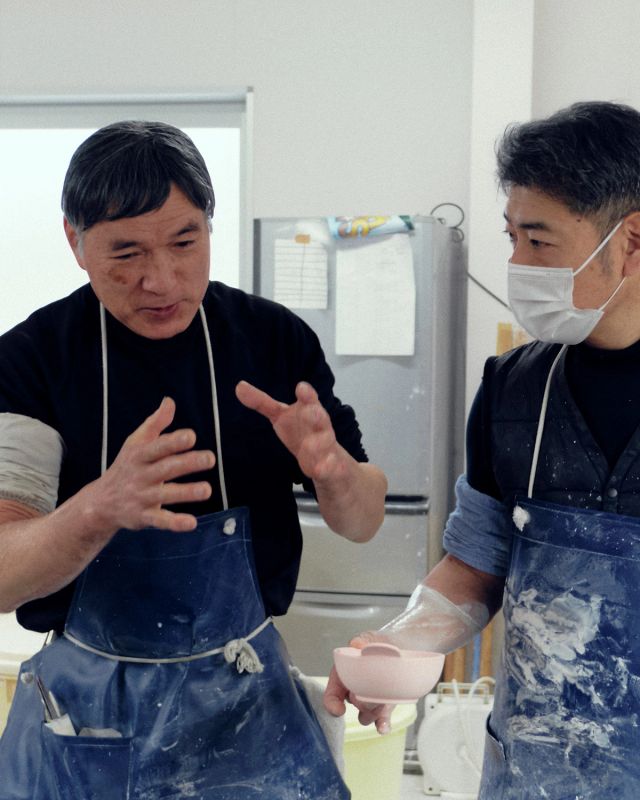
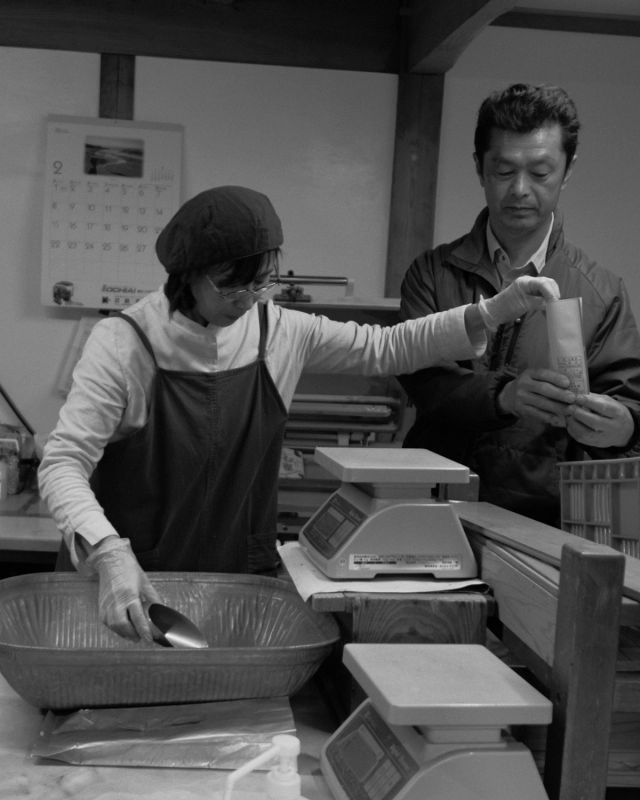
As far as the livelihood and the future of the industry in Hasami goes, it lives on by welcoming people from outside and reimagining a new life with the next generation. There was a young Japanese man we met at Tōbō Ao, a firing factory, who studied sculpture in Italy. He was looking for a place with access to a kiln in order to work on his own craft, and now lives in Hasami.
We also met an international couple at Studio Wani, run by Miriam, who is originally from Germany, and her husband, Kenichiro-san. And of course, during our stay in Hasami, we were also welcomed into the community as well.
Funnily—or perhaps coincidentally—hasami in Japanese can also mean scissors. No one knows the true etymology of the town’s name, but it feels like an apt play on words.
Scissors cannot cut unless both blades move together; in the same way, ceramic making in Hasami cannot exist unless every part of the system works as a team. Because Hasami operates as a dependent ecosystem, this is precisely why the town feels open and willing; new people and new relationships continue to be woven in, allowing Hasami to carry on into the future.